I have just discovered a new proof of the existence of God.
Consider the following sentence:
(S) If this sentence is true, then God exists.
Suppose sentence S is true. Then the first clause is satisfied, so the second clause is true. Thus, God exists.
What the preceding paragraph proves is that if sentence S is true, then God exists. But that is exactly what sentence S asserts. So that means we have proved that sentence S is true! And therefore God really does exist.
As a result of this proof I am longer an atheist. Sorry to disappoint everyone.*
* Note this proof also works for unicorns. Yay, unicorns exist!
Sunday, April 5, 2015

Tuesday, October 21, 2014
Craig and BGV
I hate writing more posts about William Lane Craig, because I think he gets way more attention than he deserves already. But.... I can't let this pass.
I just ran across this post from Craig's website. Craig is responding to Carroll and, after quoting him, replies thusly:
Either Craig hasn't understood the conclusion of the paper he cites so frequently, or he is deliberately mischaracterizing the paper for his readers so that they will think he has decisively refuted Carroll.
What do you think?
I just ran across this post from Craig's website. Craig is responding to Carroll and, after quoting him, replies thusly:
Here Carroll claims that to have a singularity in the past does not mean to have a beginning; it means only that SOME [past-directed] geodesics come to an end. He says that others might not. On this interpretation, the BGV Theorem is consistent with some geodesics’ being infinitely extended into the past. But that is precisely what the theorem proves to be impossible. The theorem requires that ALL actual, past-directed geodesics eventually come to an end. In order for the universe to be beginningless, there must be infinite, past-directed geodesics. That’s why Borde, Guth, and Vilenkin take their theorem to prove that any universe which has, on average, been in a state of cosmic expansion throughout its history cannot be past-eternal but must have a beginning.OK, so, in my last post (yeah, I know, no apologies, I'm only going to post when I feel like it, so there), I quoted the conclusion from the actual BGV paper:
... we see that if Hav > 0 along any null or noncomovingSo, it's obvious from the paper that the requirement that a geodesic ends is not applicable to geodesics that are timelike and comoving. In other words, Craig is simply wrong when he writes that BGV requires "ALL actual, past-directed geodesics eventually come to an end."
timelike geodesic, then the geodesic is necessarily
past-incomplete.
Either Craig hasn't understood the conclusion of the paper he cites so frequently, or he is deliberately mischaracterizing the paper for his readers so that they will think he has decisively refuted Carroll.
What do you think?
Friday, May 23, 2014
BGV and KCM
OK, so last time I claimed that our best, experimentally successful model of the early universe is one that is infinitely old and has no initial singularity. If you are savvy about these things (from listening to Craig debates, for instance) you are wondering, "But what about the Borde-Guth-Vilenkin theorem? Doesn't it prove that an inflating universe must have had an initial singularity?" The answer is, "No, it doesn't."
There has been a lot of confusion about this, with clip quotes from one or another of the paper's authors being traded to "prove" that the theorem does, or doesn't, prove the universe had a beginning. So let's look at what the theorem actually says.
"Any theorem is only as good as its assumptions," writes Alexander Vilenkin in a letter to Lawrence Krauss. So let's start with the assumptions of the theorem. Roughly speaking, there are two:
Now let's jump to the conclusion, which I quote from their paper:
OK, so here's my first point: the BGV theorem is not a singularity theorem!
The conclusion says nothing at all about singularities: it only says that certain paths cannot be extended infinitely backward in time. One way that this might happen is if the path encounters a singularity. But that is not the only way it can happen.
The other thing that can happen is that, as we trace the path backward in time, we encounter a region where one (or both) of the assumptions of the theorem is no longer valid.
Start with assumption (2.). The path can enter a region in which spacetime is static, or contracting, or cyclically expanding and contracting. Then assumption (2.) is violated and the theorem's conclusion is avoided. In spacetimes like these, the BGV theorem simply doesn't apply.
What about assumption (1.)? Classical spacetime is a pretty basic assumption in any sort of cosmology. But it is expected to break down in the quantum gravity regime, where we encounter "spacetime foam" of some sort. This is difficult to discuss, since in the absence of a good theory of quantum gravity, no one has any idea what spacetime foam should look like. But it's possible that the BGV theorem is pointing us to a place where quantum gravity comes into play.
So the BGV theorem does have something very interesting to tell us about the early universe: namely, that the infinitely old, infinitely expanding inflationary period that I discussed in the previous post cannot be the end of the story. Not just because of vague speculations about the Planck epoch, but because of the properties of classical spacetime itself. Here's what the authors said in the paper itself:
But the BGV theorem does not say that spacetime must be singular; still less does it say that there was an initial singularity from which the entire universe arose. This is why I say that the theorem is irrelevant to the Kalam Cosmological Argument: it doesn't say anything about whether the universe had a beginning or not.
* A few more technical points: by "backward in time" I mean in the opposite time direction from the direction in which the universe is expanding. And by "finite amount of time" I mean time as measured by a clock carried along with the moving object (proper time). In the case of null (light) rays, we have to use an "affine parameter" rather than the proper time.
There has been a lot of confusion about this, with clip quotes from one or another of the paper's authors being traded to "prove" that the theorem does, or doesn't, prove the universe had a beginning. So let's look at what the theorem actually says.
"Any theorem is only as good as its assumptions," writes Alexander Vilenkin in a letter to Lawrence Krauss. So let's start with the assumptions of the theorem. Roughly speaking, there are two:
- Spacetime is classical.
- Spacetime is expanding on average.
Now let's jump to the conclusion, which I quote from their paper:
... we see that if Hav > 0 along any null or noncomovingSome translation: a "timelike geodesic" is simply the path that an object will travel on if it is not subject to any forces other than gravity. Similarly, a "null geodesic" is the path that a light ray will travel. "Hav > 0" is the mathematical statement of assumption (2.): the universe is expanding on average. "Past-incomplete" means that if you try to follow one of these paths backwards in time, you can only do so for a finite amount of time.*
timelike geodesic, then the geodesic is necessarily
past-incomplete.
OK, so here's my first point: the BGV theorem is not a singularity theorem!
The conclusion says nothing at all about singularities: it only says that certain paths cannot be extended infinitely backward in time. One way that this might happen is if the path encounters a singularity. But that is not the only way it can happen.
The other thing that can happen is that, as we trace the path backward in time, we encounter a region where one (or both) of the assumptions of the theorem is no longer valid.
Start with assumption (2.). The path can enter a region in which spacetime is static, or contracting, or cyclically expanding and contracting. Then assumption (2.) is violated and the theorem's conclusion is avoided. In spacetimes like these, the BGV theorem simply doesn't apply.
What about assumption (1.)? Classical spacetime is a pretty basic assumption in any sort of cosmology. But it is expected to break down in the quantum gravity regime, where we encounter "spacetime foam" of some sort. This is difficult to discuss, since in the absence of a good theory of quantum gravity, no one has any idea what spacetime foam should look like. But it's possible that the BGV theorem is pointing us to a place where quantum gravity comes into play.
So the BGV theorem does have something very interesting to tell us about the early universe: namely, that the infinitely old, infinitely expanding inflationary period that I discussed in the previous post cannot be the end of the story. Not just because of vague speculations about the Planck epoch, but because of the properties of classical spacetime itself. Here's what the authors said in the paper itself:
Whatever the possibilities for the boundary [where the geodesics come to an end - RNO], it is clear that unless the averaged expansion condition can somehow be avoided for all past-directed geodesics, inflation alone is not sufficient to provide a complete description of the Universe, and some new physics is necessary in order to determine the correct conditions at the boundary. This is the chief result of our paper.
But the BGV theorem does not say that spacetime must be singular; still less does it say that there was an initial singularity from which the entire universe arose. This is why I say that the theorem is irrelevant to the Kalam Cosmological Argument: it doesn't say anything about whether the universe had a beginning or not.
* A few more technical points: by "backward in time" I mean in the opposite time direction from the direction in which the universe is expanding. And by "finite amount of time" I mean time as measured by a clock carried along with the moving object (proper time). In the case of null (light) rays, we have to use an "affine parameter" rather than the proper time.
Thursday, May 22, 2014
The Universe Is Infinitely Old (Says Cosmology)
The Secular Student Alliance at my school recently hosted a debate on the topic "Is there a God?" The theist side was very well prepared and did a great job in the debate, as even the secular students in the audience agreed. One of the arguments they presented was the Kalam Cosmological Argument, which was presented rather the same way that William Lane Craig presents it. The discussion brought up the Borde-Guth-Vilenkin Theorem (BVG for short), which Craig has used as well, as support for the premise "The universe began to exist." I want to talk about why the BVG theorem is irrelevant to the Kalam Cosmological Argument, but first, by way of preliminary, I want to discuss the current state of cosmology.
Cosmology begins with Einstein's equations of General Relativity (GR for short), and asks whether these equations, applied to the universe as a whole, are capable of explaining what we see when we look out into deep space. GR relates the curvature of spacetime to the energy content in the universe, so in order to solve the equations we need to know what the universe is filled with. There are three basic types of energy we need to consider:
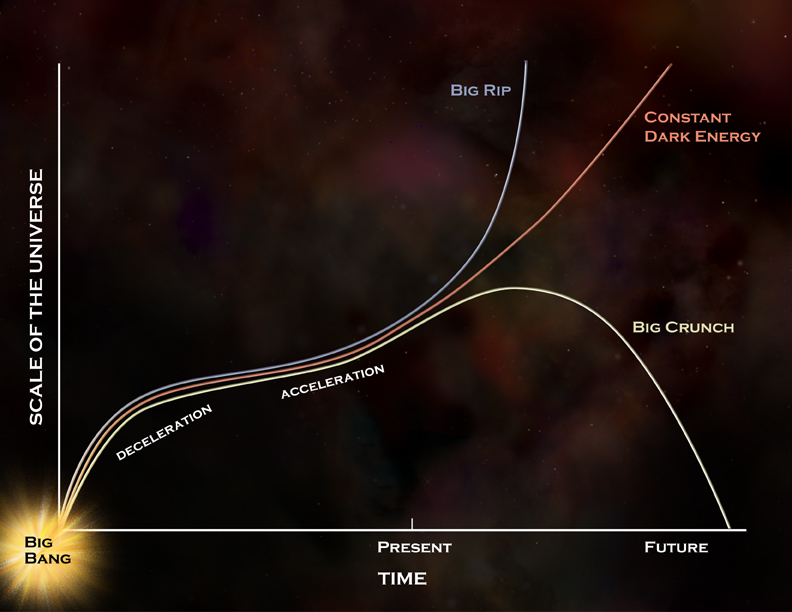
This plot shows the "scale factor" - roughly speaking, the size of some patch of the universe, as a function of time.The universe described by this model fits extremely well with the observations of distant galaxies, supernovas, quasars, etc.
If the early universe is indeed radiation dominated, then the scale factor goes to zero at some finite time in the past: that is, there is a Big Bang - an initial singularity.
However, we now have an alternative account of the earliest moments of the universe. Inflationary cosmology, proposed by Alan Guth in 1980, then in a corrected from by Linde and (independently) by Albrecht and Steinhardt in 1982 supposes that before the radiation-dominated epoch there was another epoch, dominated by a cosmological constant - but a very much larger cosmological constant than the one we measure now. I'm not going to go into the reasons these physicists thought there might have been a very large cosmological constant in the early universe, which then "switched off" (meaning it wasn't really a "constant", obviously): you can read about it at the Wikipedia page if you're interested.
The inflationary model was able to explain several features of the universe that had been puzzling in earlier cosmological models: the flatness problem, the horizon problem, and the monopole problem. In science, though, explanatory power is not enough for a theory to become accepted. In addition, a theory has to make novel predictions that are confirmed by experiment before scientists accept it as (likely to be) true.
(I can't help pointing out how different this is from theistic "explanations," in which God is claimed to be the explanation of things like life, morality, or the universe, but where there is no concern for making testable predictions about these realms.)
We now have several good reasons to think that there was in fact such an inflationary epoch. One of these is the pattern of fluctuations of the cosmic microwave background, that fits extremely well with the predictions of inflation:

Another is the very recent BICEP2 result, that seems to show the effects of quantum gravity on the polarization of the cosmic microwave background, in a way consistent with the predictions of the inflationary model.
So inflationary cosmology replaces the initial singularity with a period of exponential expansion.

How long is this inflationary period? Well, an exponential function never reaches zero, so the inflationary period is, in principle, infinitely long!
Let's sum that up: According to our best, experimentally verified model of cosmology, the universe is infinitely old and has no initial singularity!
This is the current state of our understanding of the early universe. Now, I have to admit right away that no physicist thinks the inflationary model is the end of the story. The exponential expansion is so fast that in a very short time the scale factor reaches the Planck realm, where we expect GR to break down and quantum gravity to come into play. So most diagrams of the early universe insert a quantum gravity region before the inflationary epoch. (In this diagram from Andrei Linde it's labeled "Space Time Foam.")
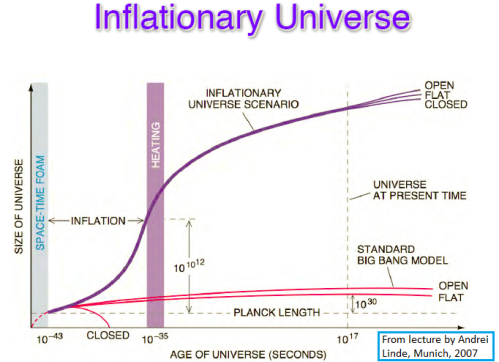
There has been much discussion of what went on before the inflationary epoch: quantum foam, the no-boundary proposal, the cyclic universe, and so on. There is even a version called "eternal inflation," in which some portion of the universe goes on inflating forever, while pocket universes like ours bubble off from time to time. In some of these models, time is finite in the past. In others, it is infinite. But all of them are pure speculation: there is to date no experimental confirmation of any of these scenarios.
Does modern cosmology support the premise that the universe had a beginning? Emphatically, no! Our best model extends infinitely into the past, with no initial singularity. We know better than to take that prediction as the last word: likewise, we know better than to take models that do exhibit an initial singularity as the last word. In short, modern cosmology allows us to draw no conclusion about whether the universe has existed for a finite or infinite amount of time. And anyone who says differently is not being completely honest.
Next time: Why the BVG theorem is irrelevant to the Kalam Cosmological Argument!
Cosmology begins with Einstein's equations of General Relativity (GR for short), and asks whether these equations, applied to the universe as a whole, are capable of explaining what we see when we look out into deep space. GR relates the curvature of spacetime to the energy content in the universe, so in order to solve the equations we need to know what the universe is filled with. There are three basic types of energy we need to consider:
- Matter in the form of galaxies, dust, dark matter, and the like,
- Radiation, including particles moving so fast that they are relativistic, and
- Cosmological constant, aka "dark energy."
This plot shows the "scale factor" - roughly speaking, the size of some patch of the universe, as a function of time.The universe described by this model fits extremely well with the observations of distant galaxies, supernovas, quasars, etc.
If the early universe is indeed radiation dominated, then the scale factor goes to zero at some finite time in the past: that is, there is a Big Bang - an initial singularity.
However, we now have an alternative account of the earliest moments of the universe. Inflationary cosmology, proposed by Alan Guth in 1980, then in a corrected from by Linde and (independently) by Albrecht and Steinhardt in 1982 supposes that before the radiation-dominated epoch there was another epoch, dominated by a cosmological constant - but a very much larger cosmological constant than the one we measure now. I'm not going to go into the reasons these physicists thought there might have been a very large cosmological constant in the early universe, which then "switched off" (meaning it wasn't really a "constant", obviously): you can read about it at the Wikipedia page if you're interested.
The inflationary model was able to explain several features of the universe that had been puzzling in earlier cosmological models: the flatness problem, the horizon problem, and the monopole problem. In science, though, explanatory power is not enough for a theory to become accepted. In addition, a theory has to make novel predictions that are confirmed by experiment before scientists accept it as (likely to be) true.
(I can't help pointing out how different this is from theistic "explanations," in which God is claimed to be the explanation of things like life, morality, or the universe, but where there is no concern for making testable predictions about these realms.)
We now have several good reasons to think that there was in fact such an inflationary epoch. One of these is the pattern of fluctuations of the cosmic microwave background, that fits extremely well with the predictions of inflation:
Another is the very recent BICEP2 result, that seems to show the effects of quantum gravity on the polarization of the cosmic microwave background, in a way consistent with the predictions of the inflationary model.
So inflationary cosmology replaces the initial singularity with a period of exponential expansion.
How long is this inflationary period? Well, an exponential function never reaches zero, so the inflationary period is, in principle, infinitely long!
Let's sum that up: According to our best, experimentally verified model of cosmology, the universe is infinitely old and has no initial singularity!
This is the current state of our understanding of the early universe. Now, I have to admit right away that no physicist thinks the inflationary model is the end of the story. The exponential expansion is so fast that in a very short time the scale factor reaches the Planck realm, where we expect GR to break down and quantum gravity to come into play. So most diagrams of the early universe insert a quantum gravity region before the inflationary epoch. (In this diagram from Andrei Linde it's labeled "Space Time Foam.")
There has been much discussion of what went on before the inflationary epoch: quantum foam, the no-boundary proposal, the cyclic universe, and so on. There is even a version called "eternal inflation," in which some portion of the universe goes on inflating forever, while pocket universes like ours bubble off from time to time. In some of these models, time is finite in the past. In others, it is infinite. But all of them are pure speculation: there is to date no experimental confirmation of any of these scenarios.
Does modern cosmology support the premise that the universe had a beginning? Emphatically, no! Our best model extends infinitely into the past, with no initial singularity. We know better than to take that prediction as the last word: likewise, we know better than to take models that do exhibit an initial singularity as the last word. In short, modern cosmology allows us to draw no conclusion about whether the universe has existed for a finite or infinite amount of time. And anyone who says differently is not being completely honest.
Next time: Why the BVG theorem is irrelevant to the Kalam Cosmological Argument!
Monday, March 17, 2014
Facts, Brute and Otherwise
Prof. Feser has responded at length to some comments I made on one of his posts. As usual, I thank him for his time and attention to my comments.
In those comments, I proposed the example of lightning striking a tree and starting a forest fire. I claimed that the lightning is still an explanation for the fire, even if the lightning itself was a brute fact (i.e. a fact having no explanation).
I realized (eventually) that my example was not the sort of explanation Feser had in mind in his original post. My example was a horizontal causal chain, in which one event causes another, which causes another, and so on, while Feser's original claim was about vertical explanatory chains: one level of explanation is in turn given a more detailed description by a lower-level explanation, which is in turn given a still-lower-level explanation. (The picture I have in mind is, for example, of a broken window that is explained at one level by the rock that hit it, but at a lower level by the fracturing properties of glass and the stresses imposed by the rock, and those properties are in turn explained by the properties of the molecules of which the glass and the rock are made, and so on.) So my example wasn't really relevant to Feser's point.
In his new post, though, Feser clearly does intend his point to apply to horizontal causal chains, so perhaps the forest fire example is relevant after all. Let me add a few more remarks.
For some reason, I'm more sympathetic to the idea that the brutishness of facts propagates vertically. I'm not sure why my intuition differentiates between the horizontal and vertical explanatory chains. The goal of physics is to describe the way the universe is in as simple and efficient a manner as possible. We physicists suppose that everything physical can be explained at bottom by the Standard Model of elementary particles, but we are content to take that theory as a brute fact. (Well, not really "content": we are always striving for a deeper explanation which will explain the structure and parameters of the Standard Model. But if we found such a theory, we would take that as a brute fact.) So in some sense the answer to any physical question is, "That's just the way the universe is." But that doesn't mean such explanations aren't useful.
Any explanation of a fact A will necessarily be in terms of other facts B, C, and D. (Unless A is self-explanatory, whatever that might mean.) B, C, and D, in turn, are either self-explanatory, or brute facts, or they are explained in terms of some further facts E, F, and G. So the whole thing can only bottom out in facts that are either self-explanatory or brute. (It seems to me that this much is true of both vertical and horizontal chains.)
If I read the professor's remarks correctly, he is saying that something can only be a real explanation if it bottoms out in only self-explanatory facts. (And that this is true of both vertical and horizontal explanatory chains.)
My response is that, if this is true, then there are hardly any examples of real explanations. In fact, maybe there has never been a real explanation in the history of humanity. For (nearly?) all actual explanations leave something else unexplained.
For instance:
What I'm saying is, any actual example of an explanation always leaves some loose ends. The regularities themselves are enough for us to claim we have an explanation: heat boils water, rock breaks window, ice makes sidewalks slippery.
Now, what Feser seems to be saying is that, though we might not know what the explanation is for the explaining facts B, C, and D, we must at least believe that there is an explanation for those facts. Otherwise we don't really have an explanation.
To this I can only respond as Keith Parsons did: I don't see why I should think this. If all actual examples of explanations leave something else unexplained, why should I deny that these are true explanations? It makes more sense to me to provide an account of explanation that reflects how we actually use explanations than to provide an account which declares by fiat that no real-world examples of explanation are true explanations.
Feser challenged me to provide an alternative account of explanation. I have done so before in previous discussions, and have not to my recollection had a response, but I am happy to repeat it here.
Consider the D-N model of scientific explanation. According to this model, an explanation of an event A consists of two things:
Let's return to the boiling pot. I can, in principle, carry my explanatory chain vertically downward, explaining the molecular properties of water in terms of the quantum mechanical properties of the atoms, and the properties of the atoms in terms of the Standard Model. There I bottom out in brute facts, from my physicist's point of view.
So here's my counter-challenge for Professor Feser: give a real explanation - in his own sense - of why the water is boiling: an explanation that bottoms out only in self-explaining facts or necessary truths.
Finally let me note that scientific explanations of the kind I've been talking about have a stunning record of success. Engines, TVs, computers, cell phones - all of modern technology stems from our ability to explain things in terms of unifying regularities. In contrast, Aristotelian explanation has been around for more than 2000 years: what practical successes can it claim?
In those comments, I proposed the example of lightning striking a tree and starting a forest fire. I claimed that the lightning is still an explanation for the fire, even if the lightning itself was a brute fact (i.e. a fact having no explanation).
I realized (eventually) that my example was not the sort of explanation Feser had in mind in his original post. My example was a horizontal causal chain, in which one event causes another, which causes another, and so on, while Feser's original claim was about vertical explanatory chains: one level of explanation is in turn given a more detailed description by a lower-level explanation, which is in turn given a still-lower-level explanation. (The picture I have in mind is, for example, of a broken window that is explained at one level by the rock that hit it, but at a lower level by the fracturing properties of glass and the stresses imposed by the rock, and those properties are in turn explained by the properties of the molecules of which the glass and the rock are made, and so on.) So my example wasn't really relevant to Feser's point.
In his new post, though, Feser clearly does intend his point to apply to horizontal causal chains, so perhaps the forest fire example is relevant after all. Let me add a few more remarks.
For some reason, I'm more sympathetic to the idea that the brutishness of facts propagates vertically. I'm not sure why my intuition differentiates between the horizontal and vertical explanatory chains. The goal of physics is to describe the way the universe is in as simple and efficient a manner as possible. We physicists suppose that everything physical can be explained at bottom by the Standard Model of elementary particles, but we are content to take that theory as a brute fact. (Well, not really "content": we are always striving for a deeper explanation which will explain the structure and parameters of the Standard Model. But if we found such a theory, we would take that as a brute fact.) So in some sense the answer to any physical question is, "That's just the way the universe is." But that doesn't mean such explanations aren't useful.
Any explanation of a fact A will necessarily be in terms of other facts B, C, and D. (Unless A is self-explanatory, whatever that might mean.) B, C, and D, in turn, are either self-explanatory, or brute facts, or they are explained in terms of some further facts E, F, and G. So the whole thing can only bottom out in facts that are either self-explanatory or brute. (It seems to me that this much is true of both vertical and horizontal chains.)
If I read the professor's remarks correctly, he is saying that something can only be a real explanation if it bottoms out in only self-explanatory facts. (And that this is true of both vertical and horizontal explanatory chains.)
My response is that, if this is true, then there are hardly any examples of real explanations. In fact, maybe there has never been a real explanation in the history of humanity. For (nearly?) all actual explanations leave something else unexplained.
For instance:
- I can explain why that pot of water is boiling by noting that it has been on a hot burner for 15 minutes.
- I can explain why the window broke by noting the rock that hit it.
- I can explain why I slipped and fell by noting the ice on the sidewalk.
What I'm saying is, any actual example of an explanation always leaves some loose ends. The regularities themselves are enough for us to claim we have an explanation: heat boils water, rock breaks window, ice makes sidewalks slippery.
Now, what Feser seems to be saying is that, though we might not know what the explanation is for the explaining facts B, C, and D, we must at least believe that there is an explanation for those facts. Otherwise we don't really have an explanation.
To this I can only respond as Keith Parsons did: I don't see why I should think this. If all actual examples of explanations leave something else unexplained, why should I deny that these are true explanations? It makes more sense to me to provide an account of explanation that reflects how we actually use explanations than to provide an account which declares by fiat that no real-world examples of explanation are true explanations.
Feser challenged me to provide an alternative account of explanation. I have done so before in previous discussions, and have not to my recollection had a response, but I am happy to repeat it here.
Consider the D-N model of scientific explanation. According to this model, an explanation of an event A consists of two things:
- A list of natural laws L1, L2, L3....
- A list of conditions C1, C2, C3.... that guarantee the laws apply in the case A.
- L1: Lightning causes fires.
- C1: There was a lightning strike.
Let's return to the boiling pot. I can, in principle, carry my explanatory chain vertically downward, explaining the molecular properties of water in terms of the quantum mechanical properties of the atoms, and the properties of the atoms in terms of the Standard Model. There I bottom out in brute facts, from my physicist's point of view.
So here's my counter-challenge for Professor Feser: give a real explanation - in his own sense - of why the water is boiling: an explanation that bottoms out only in self-explaining facts or necessary truths.
Finally let me note that scientific explanations of the kind I've been talking about have a stunning record of success. Engines, TVs, computers, cell phones - all of modern technology stems from our ability to explain things in terms of unifying regularities. In contrast, Aristotelian explanation has been around for more than 2000 years: what practical successes can it claim?
Friday, March 14, 2014
Tuesday, March 4, 2014
Bicycles and Universes
I have often imagined debating William Lane Craig myself, and thought out the ways I would respond to his arguments. I have often, while listening to Craig's debates, wondered why his opponent didn't call him on some claim that was simply untrue. Were they just being polite, or did they not realize the falsity of the claim?
I think I may be cured of these fantasies. Sean Carroll did brilliantly in the debate - far better than I could ever have done. He didn't hesitate to say outright, "That's just false!" And his deep expertise in cosmology was the perfect counterpoint to Craig's quote-mining of partially-understood physics papers.
I have only a couple of comments on style and content. I thought Sean did a good job of pointing out where Craig failed to respond to the argument. (This is an area where Craig usually excels.) But instead of merely pointing it out, he ought to have taken the opportunity to summarize his argument again, for those who might not have understood it completely the first time.
Craig, as usual, excelled in his logical organization and presentation of his argument. His concluding summary nicely recalled his original point: not that he was out to prove God's existence, but that modern cosmology lends support to one of his premises.
Here Carroll really missed an opportunity. He ought to have said, briefly and succinctly, that modern cosmology lends no support at all the premise that the universe had a beginning. What we can say for sure is that the universe was a very different place 13.7 billion years ago. But any statement about what happened before that is very speculative and unfounded in established science. There are models in which time has a beginning, and there are models in which it doesn't: none of these models are established science, and so nothing can be deduced from them about a beginning.
One final missed opportunity: when Craig asked, quite reasonably, "If universes can just pop into existence, why not bicycles? What's the difference?" (from memory, not an exact quote) Sean could have responded that there is an obvious and crucial difference: bicycles are things that exist within time, while universes are not. On the contrary, time exists within a universe. For all Craig's bluster about simultaneous causation in the Q&A session, causality has to do with what brings about a change. And for there to be change, there must be time. Since a universe is not something that happens in time, the causality issue doesn't apply.
I think Sean probably had something like this in mind in his argument about the a cosmological model as a self-contained description needing no outside cause, but it would have been nice to respond to Craig's question with a specific difference that clearly matters.
Monday, March 3, 2014
Craig, Carroll, and Cause
Since I've been reading about causes, one part of the debate that stood out for me was the fact that neither Carroll nor Craig tried to define "cause." In terms of the debate, this was undoubtedly wise: a long digression on the different definitions of "cause" would probably have lost most of the audience. But it was bad philosophy. Carroll tried to explain that, for a physicist, having a consistent mathematical model that comports with the experimental evidence is all we need. Any discussion of causes and effects will proceed from that model. Craig simply kept repeating his argument from incredulity: a universe can't just pop into being without a reason.
But certainly, how we think about causation affect our ideas on whether a self-contained universe needs a cause.
(By the way, this issue is independent of whether the universe in question has a beginning or not. While it might seem intuitively that a universe that begins is more guilty of "just popping" into existence, it has often been argued that a universe that is infinite in time is no less in need of some sort of external cause or explanation.)
On Hume's regularity view, causation is a matter of constant conjunction: to know that A causes B, we need to know that A is always followed by B. So what we need to do is to make lots of observations of deities, and if "Let there be light!" is always followed by a universe popping into existence, then we can conclude that gods cause universes.
On Wesley Salmon's analysis, a causal process is one that can carry some sort of a mark that transmits from the cause to the effect. It would seem, though, that if God is perfect, God is impossible to mark. Thus, we could never tell if a mark can be passed to the universe.
Another modern approach is to take causation to involve the transmission of a conserved quantity, like energy or momentum. But neither the theist not the atheist would claim that a universe that has a beginning in time was initiated by a transfer of pre-existing energy, so in this case there is no possibility of a cause.
On the Aristotelian-Thomian analysis, causation involves a potentiality becoming actuality, and an external cause is necessary to tip something into actuality. A universe is obviously possible (if it were impossible we wouldn't be here), so on this analysis an external cause is needed to make the universe actual.
So it seems possible, in principle at least, that both Craig and Carroll are right: differing definitions of "cause" may yield different conclusions about whether a self-contained universe requires a cause.
Tuesday, February 25, 2014
Two Debates
There have been two very recent debates between high-profile Christians and scientifically-minded opponents.
I'm not that interested in the Ken Ham vs. Bill Nye the Science Guy debate, as Ham's creationist views have no credibility whatsoever. It would be interesting to see what approach Bill took. Some reviews have been positive, others not so.
I'm much more interested in the William L. Craig vs. Sean Carroll debate. Unfortunately, there doesn't seem to be video available for it yet. [ETA: Video now available here.] WLC is infamous in atheist circles for "winning" most of his debates. ("Winning" is of course very subjective in informal debates like these, but when the folks on the opposing side think you won, you probably won.) Carroll is not only a cosmology expert, he is one of the most philosophically astute scientists I know of - he's light-years ahead of Lawrence Krauss or Jerry Coyne, in my opinion. So Carroll is probably the ideal opponent for WLC. Props to WLC for taking on Carroll on his home turf: cosmology. This was either very brave or very stupid of him.
Carroll's own views on the debate are here. (I don't see any comments on it on Craig's website yet.) I think it's not just atheistic bias to assume that, where they disagree on the cosmology, the cosmology expert is probably right.
One new thing I learned from Sean's comments: Some cosmologies have a Boltzmann Brain problem and others don't. That's something I'll have to learn more about.
Craig has employed modern cosmology extensively in the past, both in debates and in his published papers. I was glad to see that Sean brought up the big problem with this: some cosmological models have an infinite past. Others don't. None of these models is considered established physics. So cosmology tells us nothing (yet!) about whether the universe had a beginning or not.
I really like Sean's five responses to the fine tuning argument - especially his #2, which is basically the same as my Fine Tuning Argument for Naturalism. Craig apparently had no response to this point.
There's been a lot of discussion about whether these debates are a good idea or not, from the point of view of promoting science and rational thought, much of it focussed on whose resume will be enhanced and whose pockets will be filled. From the purely intellectual point of view, I'm all for them. It's true that debates are a poor format for getting to the truth, but they're a great format for exposing folks to ideas they might not have encountered otherwise.
Saturday, February 22, 2014
Evolution and Entropy, Again
I just got an email from someone who had read my essay about evolution and the second law of thermodynamics and thought he had found a flaw in it. It made me realize that the discussion there is rather technical and mathematical, and I ought to write up the basic idea in a clear and non-mathematical way. So here goes.
The thermodynamic argument against evolution goes something like this:
Secondly, even if (1.) is true, the argument fails, because (2.) is wrong: the second law of thermodynamics doesn't say that entropy never decreases.
In fact, entropy decreases spontaneously in lots of natural settings: for instance, when a pond freezes over in winter. Ice has much less entropy than liquid water - if it were impossible for entropy to decrease then it would be impossible for ponds to freeze over.

So what does the second law of thermodynamics say? It says that there can't be a decrease of entropy in one place without a compensating increase of entropy somewhere else. In the case of the pond, the heat escaping from the water during the freezing process causes an increase of entropy of the air over the pond.
If you wanted to prove that the freezing of the pond violates the second law of thermodynamics, you would have to calculate the entropy decrease of the water, calculate the entropy increase of the air, and show that the latter is less than the former.
In the case of evolution, you would have to calculate the entropy decrease due to cells being "organized" into higher life forms, which, we already noted, has never been done. Then you would have to show there was no compensating increase of entropy elsewhere. This second step is what I addressed in my essay. If we take the whole Earth as our system, then we find there is an absolutely enormous increase of entropy due to the radiation of heat energy into space. This entropy increase is so large that no possible decrease of entropy due to evolution would cause a violation of the second law of thermodynamics.
The thermodynamic argument against evolution goes something like this:
- Evolution involves an increase of order, and therefore a decrease of entropy.
- The second law of thermodynamics says that entropy never decreases.
- Therefore, evolution contradicts the second law of thermodynamics.
Secondly, even if (1.) is true, the argument fails, because (2.) is wrong: the second law of thermodynamics doesn't say that entropy never decreases.
In fact, entropy decreases spontaneously in lots of natural settings: for instance, when a pond freezes over in winter. Ice has much less entropy than liquid water - if it were impossible for entropy to decrease then it would be impossible for ponds to freeze over.
So what does the second law of thermodynamics say? It says that there can't be a decrease of entropy in one place without a compensating increase of entropy somewhere else. In the case of the pond, the heat escaping from the water during the freezing process causes an increase of entropy of the air over the pond.
If you wanted to prove that the freezing of the pond violates the second law of thermodynamics, you would have to calculate the entropy decrease of the water, calculate the entropy increase of the air, and show that the latter is less than the former.
In the case of evolution, you would have to calculate the entropy decrease due to cells being "organized" into higher life forms, which, we already noted, has never been done. Then you would have to show there was no compensating increase of entropy elsewhere. This second step is what I addressed in my essay. If we take the whole Earth as our system, then we find there is an absolutely enormous increase of entropy due to the radiation of heat energy into space. This entropy increase is so large that no possible decrease of entropy due to evolution would cause a violation of the second law of thermodynamics.
Wednesday, February 12, 2014
Victor, Meet Ken
Victor Reppert's blog, Dangerous Idea, has been on my blogroll for a while. I try to look for blogs that express the theist's viewpoint in an intelligent manner, and Reppert is a Christian who has some philosophical acumen and whose arguments have often seemed worthy of consideration. Recently, though, his posts have been declining in both length and quality. Now he has hit a new low. Here's a recent post, in its entirety:
Of course it's up to the person making the claim to provide the proof. And scientists have done that - and published their results - and repeated those demonstrations again and again for generations of students.
Please tell me, Victor, how do I go about repeating the results of the religious "authorities"?
You can go to a Chinese physicist, a Russian physicist, a South African physicist, a Brazilian physicist, an Australian physicist, and ask them the charge of the electron, and they will all give you the same answer.
If I go to a Hindu religious authority, a Muslim religious authority, a Roman Catholic religious authority, a Sikh religious authority, a Buddhist religious authority, and a Shinto religious authority, will they give me the same answer to my religious questions?
Whole industries now rely on our understanding of electrons. Every time you make a phone call, watch TV, or type a blog post, you are effectively performing an experiment that confirms the properties of electrons. We trust that understanding enough to stake our very lives on it, every time we get on a plane, train, or automobile.
What discoveries or declarations of religious authorities are so reliable that people all over the world stake their lives on them?

"What's the difference," you ask?
One word: EVIDENCE
Here's the difference, Victor: anyone who disbelieves the authorities can repeat the experiments on their own. Electrons, you say? How about the Millikan oil drop experiment, the Compton effect, the q/m experiment, the Franck-Hertz experiment? How about examining the fine structure of hydrogen? If you're unsure about electrons, try one of these experiments and see what you get. I've done several of them myself, and can vouch for the results.Atheists often make the claim that the burden of proof lies with the believer, not the unbeliever. They would ask whether you can prove that the nonexistence of anything. Rather, it should be up to the person who makes the positive claim to provide proof, not the people trying to prove a negative.However, there are many things that are invisible that I might have trouble proving. Let's take electrons, for example. I've never seen one myself. Many people believe in them simply on the authority of scientists. People also believe in God, even though they can't see God, because they take his existence on the basis of authorities. What's the difference?
Of course it's up to the person making the claim to provide the proof. And scientists have done that - and published their results - and repeated those demonstrations again and again for generations of students.
Please tell me, Victor, how do I go about repeating the results of the religious "authorities"?
You can go to a Chinese physicist, a Russian physicist, a South African physicist, a Brazilian physicist, an Australian physicist, and ask them the charge of the electron, and they will all give you the same answer.
If I go to a Hindu religious authority, a Muslim religious authority, a Roman Catholic religious authority, a Sikh religious authority, a Buddhist religious authority, and a Shinto religious authority, will they give me the same answer to my religious questions?
Whole industries now rely on our understanding of electrons. Every time you make a phone call, watch TV, or type a blog post, you are effectively performing an experiment that confirms the properties of electrons. We trust that understanding enough to stake our very lives on it, every time we get on a plane, train, or automobile.
What discoveries or declarations of religious authorities are so reliable that people all over the world stake their lives on them?
"What's the difference," you ask?
One word: EVIDENCE
Saturday, February 8, 2014
Against Cause
In an attempt to gain a better understanding of modern views of causation, I've been reading Causation and Explanation, by Stathis Psillos. So far what I've learned is this: modern views of causation are a mess. There are intrinsic and extrinsic views, reductive and non-reductive views, the "marker" view, and the "conserved quantity" view. There is no agreement on whether Hume's regularity view of causation needs to be improved upon, or abandoned and replaced with something quite different.
Over at The Edge, there is the annual Edge Question event. This year's question: What scientific idea is ready for retirement? Go read the responses, they're very interesting and very short.
Among the responses, W. Daniel Hillis suggests we retire the concept of cause and effect. Causes, he suggests, are just parts of a story we tell about the world.
So maybe the reason philosophers can't find a decent characterization of causes is that they are not really a part of the universe. Rather, they are something we invent - maybe in a rather haphazard and inconsistent manner - to help us track important aspects of the world around us.
Over at The Edge, there is the annual Edge Question event. This year's question: What scientific idea is ready for retirement? Go read the responses, they're very interesting and very short.
Among the responses, W. Daniel Hillis suggests we retire the concept of cause and effect. Causes, he suggests, are just parts of a story we tell about the world.
Science is a rich source of powerful explanatory stories. For example, Newton explained how a force causes a mass to accelerate. This gives us a story of how an apple drops from a tree or a planet circles around the Sun. It allows us to decide how hard the rocket engine needs to push to get it to the Moon. Models of causation allow us to design complex machines like factories and computers that have fabulously long chains of causes and effects. They convert inputs into the outputs that we want.These stories can be very useful, but they can also be misleading.
It is tempting to believe that our stories of causes and effects are how the world works. Actually, they are just a framework that we use to manipulate the world and to construct explanations for the convenience of our own understanding.
So maybe the reason philosophers can't find a decent characterization of causes is that they are not really a part of the universe. Rather, they are something we invent - maybe in a rather haphazard and inconsistent manner - to help us track important aspects of the world around us.
Thursday, February 6, 2014
Where's Evil?
Where's evil? It's that large part of every man that wants to hate without limit, that wants to hate with God on its side.
(Kurt Vonnegut, Mother Night)
Saturday, January 11, 2014

Sunday, December 22, 2013
Physics Lies!
I've been bashing the theists for a while, so I'm going to take a break and bash an atheist for a change.
Nancy Cartwright is the author of How the Laws of Physics Lie, and is apparently an influential philosopher. Kitcher mentions her in his Mind and Cosmos review, she is regularly included in anthologies of important papers in the philosophy of science, and her term "Dappled World" (borrowed from Manley Hopkins, according to Kitcher) seems to have become a sort of rallying point for modern philosophical views of science.
I think her work is shoddy and unconvincing.
OK, choosing that title for her book is like waving a cape in front of a bull, I suppose. But I really tried to give her a fair hearing, honest I did. Readers of this blog can, I suppose, judge how good I am at giving a fair hearing to views I disagree with. But let me try to present her argument before I tear it apart.
The Laws of Physics Lie
In Essay 3 of the book, Cartwright lays out the case that the laws of physics are not true, or, to the extent they are true, they are not interesting. In fact, they are not even approximately true. Why?
She illustrates with Newton's law of universal gravitation. For the definition of this law she quotes Feynman:
For instance, in an atom, the law of gravitation is swamped by the Coulomb force and so the former is not even approximately true.
Notice that she is not complaining about extreme cases where Newtonian gravitation must be replaced by General Relativity. Her complaint is that the law doesn't state a fact: except, perhaps, in a universe completely empty except for two uncharged objects.
She considers an alternate version of NG1 that uses a prefatory clause to correct the deficiency:
This, she allows, may be a true law, but it is not a very interesting one, for in reality objects have both kinds of properties (mass and electric charge) and so NG2 has no (or very few) applications in reality.
From a physicist's point of view, this is all very wrong-headed. First of all, since she is talking about combining different influences, the law she ought to be talking about is Newton's second law of motion:
With this change, I submit, we have a law that is at least approximately true, with no further need of ceteris paribus clauses.
This is such a simple solution to Cartwright's difficulty that it's hard to believe she missed it. However, she does go on to discuss the law of vector composition of forces, and then to consider a suggestion of Lewis Creary that is similar to NG3. Let's consider what she has to say about these issues.
Vector Addition
Cartwright admits that physicists have an answer to the question of combining forces: she calls it the "vector addition story."
But this is quite obviously false. Consider, for example, a spring that is subject to equal and opposite forces on its two ends:

The net force is zero, so the center of mass of the spring doesn't accelerate. But the spring is compressed - the component forces have a real, physical effect.
Try telling this guy that the component forces aren't real:

Cartwright is essentially saying "'two apples plus one apple equals three apples' can't be true, because if the two apples and the one apple are real, and the three apples are real, then I would have six apples, not three." But this is just silly: two apples plus one apple equals three apples because that's simply what addition means, when applied to apples. Similarly, in the vector addition of forces, two real, occurrent forces can be added to make a real net force, because that's simply what it means to combine two forces.
For this, Cartwright deserves an award for Worst Misuse of Mathematics By a Professional Philosopher Not Named Craig.
Causal Action
Cartwright then turns to Creary, who claims that there are two types of physical laws: laws of causal influence and laws of causal action. Though she doesn't say so, in Newton's mechanics, the law of causal action is good old F = ma (NA).
Apparently Cartwright doesn't know about quantum mechanics, where Schroedinger's equation gives a general law, or quantum field theory, where the Lagrangian path integral does the same.
Anyway, it makes no sense to claim that there are no true fundamental laws of physics, except for those few cases where the laws are both fundamental and true. Naturally, if there are general laws of action, and if physics is a more or less unified subject, then we would expect the general laws to be few. The fact that there are only a few such fundamental laws actually shows the strength of the reductionist thesis rather than the opposite.
On the other hand, if her point is just that most of the time, working physicists are not dealing with the fundamental laws, but with some approximations to them, or phenomenological laws that are not fundamental, then I would agree with her, but find the point trite and uninteresting. These physicists wouldn't ever claim that their approximations are true in all cases.
Actually, Cartwright does know about quantum mechanics, because in the very next section she discusses a quantum example: the spectrum of a carbon atom. What she says here is so pathetic that I can't bear to grind through it point by point. Essentially, she again ignores the general law of action (Schroedinger's equation) in order to make her point that there is no general law of action.
At first I thought Cartwright had simply not bothered to understand the physics before she began drawing philosophical conclusions. But later in the book she shows a detailed understanding of some much more difficult areas of physics, so that doesn't seem to be the problem.
The only other explanation I can think of for these egregious errors is that Cartwright is working with a pre-conceived agenda, such that all the examples are contorted so as to support her thesis.
This is no way to ground a philosophical world view.
Nancy Cartwright is the author of How the Laws of Physics Lie, and is apparently an influential philosopher. Kitcher mentions her in his Mind and Cosmos review, she is regularly included in anthologies of important papers in the philosophy of science, and her term "Dappled World" (borrowed from Manley Hopkins, according to Kitcher) seems to have become a sort of rallying point for modern philosophical views of science.
I think her work is shoddy and unconvincing.
OK, choosing that title for her book is like waving a cape in front of a bull, I suppose. But I really tried to give her a fair hearing, honest I did. Readers of this blog can, I suppose, judge how good I am at giving a fair hearing to views I disagree with. But let me try to present her argument before I tear it apart.
The Laws of Physics Lie
In Essay 3 of the book, Cartwright lays out the case that the laws of physics are not true, or, to the extent they are true, they are not interesting. In fact, they are not even approximately true. Why?
She illustrates with Newton's law of universal gravitation. For the definition of this law she quotes Feynman:
(NG1) The Law of Gravitation is that two bodies exert a force between each other which varies inversely as the square of the distance between them, and varies directly as the product of their masses.Then she asks, and answers:
Does this law truly describe how bodies behave?Why not? Well, she says, two bodies may have electric charges, and so the force exerted by one on the other is given neither by NG1 nor by Coulomb's law of electric force, but by a combination of the two. Therefore
Assuredly not.
These two laws are not true: worse, they are not even approximately true.
For instance, in an atom, the law of gravitation is swamped by the Coulomb force and so the former is not even approximately true.
Notice that she is not complaining about extreme cases where Newtonian gravitation must be replaced by General Relativity. Her complaint is that the law doesn't state a fact: except, perhaps, in a universe completely empty except for two uncharged objects.
She considers an alternate version of NG1 that uses a prefatory clause to correct the deficiency:
(NG2) If there are no forces other than gravitational forces at work, then two bodies exert a force between each other which varies inversely as the square of the distance between them, and varies directly as the product of their masses.
This, she allows, may be a true law, but it is not a very interesting one, for in reality objects have both kinds of properties (mass and electric charge) and so NG2 has no (or very few) applications in reality.
From a physicist's point of view, this is all very wrong-headed. First of all, since she is talking about combining different influences, the law she ought to be talking about is Newton's second law of motion:
(NA) The acceleration of an object is proportional to the net force and inversely proportional to its mass.Somehow, she completely avoids mentioning this law anywhere in the chapter (though she mentions it obliquely in considering a related objection, as we will see below). Since she doesn't mention NA, I don't know whether she considers this one of laws that is not even approximately true. But you can't talk about gravitational and electric forces combining without it. With this framework in mind, there is an obvious alternative to NG1 and NG2:
(NG3) For two massive bodies, there is a contribution to the net force that varies inversely as the square of the distance between them, and varies directly as the product of their masses.
With this change, I submit, we have a law that is at least approximately true, with no further need of ceteris paribus clauses.
This is such a simple solution to Cartwright's difficulty that it's hard to believe she missed it. However, she does go on to discuss the law of vector composition of forces, and then to consider a suggestion of Lewis Creary that is similar to NG3. Let's consider what she has to say about these issues.
Vector Addition
Cartwright admits that physicists have an answer to the question of combining forces: she calls it the "vector addition story."
The vector addition story is, I admit, a nice one. But it is just a metaphor. We add forces... when we do calculations. Nature does not 'add' forces.For the component forces are not there, in any but a metaphorical sense, to be added....For Cartwright, the individual component forces are not real. Only the net force is real.
But this is quite obviously false. Consider, for example, a spring that is subject to equal and opposite forces on its two ends:
The net force is zero, so the center of mass of the spring doesn't accelerate. But the spring is compressed - the component forces have a real, physical effect.
Try telling this guy that the component forces aren't real:
Cartwright is essentially saying "'two apples plus one apple equals three apples' can't be true, because if the two apples and the one apple are real, and the three apples are real, then I would have six apples, not three." But this is just silly: two apples plus one apple equals three apples because that's simply what addition means, when applied to apples. Similarly, in the vector addition of forces, two real, occurrent forces can be added to make a real net force, because that's simply what it means to combine two forces.
For this, Cartwright deserves an award for Worst Misuse of Mathematics By a Professional Philosopher Not Named Craig.
Causal Action
Cartwright then turns to Creary, who claims that there are two types of physical laws: laws of causal influence and laws of causal action. Though she doesn't say so, in Newton's mechanics, the law of causal action is good old F = ma (NA).
On Creary's account, Coulomb's law and the law of gravity come out true because they correctly describe what influences are produced.... The vector addition law then combines the separate influences to predict what motions will occur.
This seems to me to be a plausible account of how a lot of causal explanation is structured. But as a defence of the truth of fundamental laws, it has two important drawbacks. First, in many cases there are no general laws of interaction... In fact, classical mechanics may well be the only discipline where a general law of action is always available.
Apparently Cartwright doesn't know about quantum mechanics, where Schroedinger's equation gives a general law, or quantum field theory, where the Lagrangian path integral does the same.
Anyway, it makes no sense to claim that there are no true fundamental laws of physics, except for those few cases where the laws are both fundamental and true. Naturally, if there are general laws of action, and if physics is a more or less unified subject, then we would expect the general laws to be few. The fact that there are only a few such fundamental laws actually shows the strength of the reductionist thesis rather than the opposite.
On the other hand, if her point is just that most of the time, working physicists are not dealing with the fundamental laws, but with some approximations to them, or phenomenological laws that are not fundamental, then I would agree with her, but find the point trite and uninteresting. These physicists wouldn't ever claim that their approximations are true in all cases.
Actually, Cartwright does know about quantum mechanics, because in the very next section she discusses a quantum example: the spectrum of a carbon atom. What she says here is so pathetic that I can't bear to grind through it point by point. Essentially, she again ignores the general law of action (Schroedinger's equation) in order to make her point that there is no general law of action.
At first I thought Cartwright had simply not bothered to understand the physics before she began drawing philosophical conclusions. But later in the book she shows a detailed understanding of some much more difficult areas of physics, so that doesn't seem to be the problem.
The only other explanation I can think of for these egregious errors is that Cartwright is working with a pre-conceived agenda, such that all the examples are contorted so as to support her thesis.
This is no way to ground a philosophical world view.
Thursday, December 19, 2013
A Natural Reduction
One of the great advantages of the naturalist world view is how it all hangs together. The workings of the mind can be explained in terms of the workings of the brain, which can be explained in terms of the workings of the brain cells, which can be explained in terms of the electrical and chemical properties of molecules, which can be explained in terms of the physical properties of the particles of which those molecules are composed. And the same goes for anything else in the universe: stars, moons, clovers....
Now, I will admit that some of the links in that proposed chain of explanation are not as strong as others: the mind-brain link, for example. But the overall scheme seems sound, and the naturalistic world view can count innumerable successes as evidence of its truth: the technologies of transportation, agriculture, communication, medicine, and psychiatry, to mention just a few. Put this against the abject failure of alternative ways of thinking: what did Christianity (just to pick on one alternative) accomplish in the 1500 years before scientific thinking arose?
At any rate, even when precise explanations are lacking, there doesn't seem to be any strong argument why the gaps cannot be filled out in a naturalistic way.
It seems, though, that many atheist philosophers are no longer satisfied with this reductionistic picture. The recent book Mind and Cosmos, by atheist philosopher Thomas Nagel, argues that there are aspects of subjective experience that can't be explained by reductionistic means. (Short version here.) Another atheist philosopher, Philip Kitcher, whom I have the greatest respect for, disagrees with Nagel but seems to agree that the reductionist program has not accomplished the task it set out to do. "Unity fails at both ends," writes Kitcher.
For once, I agree with Professor Feser: if naturalism fails to give us a unified picture of everything, then it is time to abandon naturalism and seek a different explanation, rather than to cling to a failed program.
But I am not as pessimistic as these philosophers. Perhaps that's merely ignorance on my part. But some of the anti-reductionist arguments I've come across seem just silly, and, as I already said, there don't seem to be any good arguments for the impossibility of naturalistic explanation. I remain a hard-core reductionist, and I'm going to try to defend that view.
Next: Do the laws of physics lie?
Tuesday, November 26, 2013
Determined by What?
Kripke is central to Ross's argument, and it is certainly true that both Ross and Kripke take his point to be a metaphysical (not just an epistemological) one, so it is fair of Professor Feser to require a more detailed argument that the one I gave in my first post on Ross. I still think that what I wrote there was basically correct, and that Feser has not adequately countered my objection. But let me try to say it again, more clearly and (I hope) convincingly.
I was helped immensely in my understanding of the structure of Kripke's argument by a critical response to Kripke by Scott Soames. In an intricate bit of philosophical analysis, Soames shows that Kripke is equivocating between two different meanings of "determine." I think Ross is making a similar, but more basic, mistake, as I will explain.
What does it mean for a set of facts (F) to determine another set of facts (G)? This is the fundamental issue of determinacy. In order to be clear about Ross's argument, we need to know what he thinks F is, what he thinks G is, and what he means by "determine." For Soames, the problem lies in the last of these. For Ross, it lies in the other two.
The first thing we have to get clear is that Ross is not talking about the indeterminateness of meaning, Feser's claims notwithstanding. If he were, he would have to discuss the meaning of "meaning", as Kripke (?) and Soames do. Also, because Kripke's argument leads to skepticism about whether humans ever mean anything, as well as machines, Ross would owe us an account of how he can avoid the skeptical conclusion about humans while affirming skepticism about machines. But he does none of this. Indeed, as one commenter noted at the beginning of the discussion, Ross never mentions "meaning" in the article. Furthermore, neither Ross nor the naturalist thinks an adding machine means anything when it performs an operation, so if meaning were the issue, the entire discussion about the adding machine would be beside the point.
So the short reply to Ross' use of Kripke is that Ross has divorced the quaddition argument from the Kripkean context. The result is that quaddition becomes simply another version of the problem of limited data. And we have already seen that the problem of limited data helps Ross not at all. If you are convinced of this point, you can skip the rest of this too-long post. What follows simply expands and explains this point.
Ross never discusses meaning - his discussion is entirely about whether the machine is executing a function, and whether the machine's future outputs are determinate. Let's look again at the way he begins his argument:
[Emphasis added]
I interpret Ross to be saying that what is not determined - his G - is what function the system is computing. Further, on the basis of the preceding quotes, I take it that he cashes out this G in terms of
a) what the system might output at a future time, and
b) what the system would have output for inputs it might have had, but did not have.
Let's consider a system with two inputs, x and y. Then the question is, "Is the output z determined for every possible x and y?"
Now we come to central question: determined by what? What is Ross's set F - the facts that (fail to) determine the output, z?
Since we are considering a purely physical system, a prime candidate for F would be the set
F1: All the physical facts about the system.
In this case, the question being asked becomes "Is the output z determined by the physical facts about the system, for all possible inputs x and y?" But this is nothing more nor less than the question of physical determinism. In a deterministic world, the set F1 certainly does determine the possible outputs, z, even for cases that the machine hasn't actually computed. Setting aside issues of quantum indeterminacy (which Ross never mentions), it seems that all outputs are determined by F1.
But F1 is not what Ross has in mind. He never attempts any discussion of physical determinism. Instead, he seems to have in mind something like
F2: The physical facts that are known about the system at some time T.
I take this from his talk of the "discriminable features of a physical process" in the first quote above and from his talk of "empirical adequacy," though I have to say that Ross is extremely vague about this.
If this is Ross's argument - if he is saying "What the system might have done, or will do, is not determined by the physical facts that we know about the system" - then we should simply reply, "So what?" As we saw already with the problem of limited data, there is no way to argue from an epistemological lack to a metaphysical conclusion.
There is another possibility: suppose that, instead of the physical facts that are known about the system, what Ross really means is
F3: All the physical facts that can be known about the system.
But now we have to be careful. What does is mean to say something "can be known"? Does this mean all the physical facts that can in principle be known about the system? Then F3 is the same as F1 - all the physical facts about the system can in principle be known (barring quantum uncertainty). In that case, there is no reason to think the outputs are undetermined. However, in actual fact we can never know all the physical facts about the system, no matter what set of observations we make. Thus, any given set of observations, no matter how detailed, is consistent with incompatible functions. Does this justify Ross's conclusion? No, because in that case, there is again only an epistemological lack.
Let me explain the last remark using the example of a computer. The computer seems at first to be a simple counterexample to Ross's claim that the outputs z are not determined by the physical features of the system. For I can look at the program the computer is running (it is encoded physically somewhere in the computer's memory) and see what the function is: I can deduce, for example, what the output would have been for some inputs x and y that the computer has not actually calculated. But (as Feser points out) a wire might burn out or a transistor go bad inside the computer, so that the actual output is not what the computer program would lead us to believe. This is true, but it doesn't really answer the objection. For suppose I insist on a more detailed physical description of the computer: one so detailed that the failure of the wire/transistor is predictable by this description and so is accounted for. Then we see that the indeterminacy was only apparent: the output is in fact determined by this more detailed set of facts. (In this case the computer would be executing something like quaddition, rather than addition.) If we dig deep enough, we will always find some set of physical facts that do determine the output.
We can now see why Ross is wrong to say that "for a machine process to be fully determinate, every output for a function would have to occur." A sufficiently detailed set of physical facts about the system determines not only what outputs will occur at a future time, but also what outputs would have occurred for other inputs that were not actually submitted to the machine.
I have gone into this at length because I think it shows both why Ross's argument is so appealing and why it is wrong. For any given set of physical facts about the system, there are infinitely many inequivalent functions compatible with the behavior of the system. But the set of possible observations is not fixed: if we find a particular set of physical facts leaves the outcome undetermined, we can always ask for a more detailed description of the system. For a sufficiently detailed set of physical facts, we find the outcome is determined by those facts. What makes the argument seem reasonable is the slide from a given set of facts, to any possible set of facts, to all physical facts.
To summarize:
None of this addresses Professor Feser's point about the meaning of a physical process, which I will have to address (I hope!) another time.
* I take Ross to mean "inequivalent" rather than "incompossible" here and throughout - see Richard's remarks in the previous post.
I was helped immensely in my understanding of the structure of Kripke's argument by a critical response to Kripke by Scott Soames. In an intricate bit of philosophical analysis, Soames shows that Kripke is equivocating between two different meanings of "determine." I think Ross is making a similar, but more basic, mistake, as I will explain.
What does it mean for a set of facts (F) to determine another set of facts (G)? This is the fundamental issue of determinacy. In order to be clear about Ross's argument, we need to know what he thinks F is, what he thinks G is, and what he means by "determine." For Soames, the problem lies in the last of these. For Ross, it lies in the other two.
The first thing we have to get clear is that Ross is not talking about the indeterminateness of meaning, Feser's claims notwithstanding. If he were, he would have to discuss the meaning of "meaning", as Kripke (?) and Soames do. Also, because Kripke's argument leads to skepticism about whether humans ever mean anything, as well as machines, Ross would owe us an account of how he can avoid the skeptical conclusion about humans while affirming skepticism about machines. But he does none of this. Indeed, as one commenter noted at the beginning of the discussion, Ross never mentions "meaning" in the article. Furthermore, neither Ross nor the naturalist thinks an adding machine means anything when it performs an operation, so if meaning were the issue, the entire discussion about the adding machine would be beside the point.
So the short reply to Ross' use of Kripke is that Ross has divorced the quaddition argument from the Kripkean context. The result is that quaddition becomes simply another version of the problem of limited data. And we have already seen that the problem of limited data helps Ross not at all. If you are convinced of this point, you can skip the rest of this too-long post. What follows simply expands and explains this point.
Ross never discusses meaning - his discussion is entirely about whether the machine is executing a function, and whether the machine's future outputs are determinate. Let's look again at the way he begins his argument:
Whatever the discriminable features of a physical process may be, there will always be a pair of incompatible predicates, each as empirically adequate as the other, to name a function the exhibited data or process "satisfies." That condition holds for any finite actual "outputs," no matter how many. That is a feature of physical process itself, of change. There is nothing about a physical process, or any repetitions of it, to block it from being a case of incompossible* forms ("functions"), if it could be a case of any pure form at all. That is because the differentiating point, the point where the behavioral outputs diverge to manifest different functions, can lie beyond the actual, even if the actual should be infinite; e.g., it could lie in what the thing would have done, had things been otherwise in certain ways. For instance, if the function is x(*)y = (x + y, if y < 1040 years, = x + y + 1, otherwise), the differentiating output would lie beyond the conjectured life of the universe.And later on:
Secondly, opposed functions that are infinite (that is, are a "conversion" of an infinity of inputs into an infinity of outputs) can have finite sequences, as large as you like, of coincident outputs; they can even have subsequences that are infinitely long and not different (e.g., functions that operate "the same" on even numbers but differently on odd numbers). So for a machine process to be fully determinate, every output for a function would have to occur. For an infinite function, that is impossible. The machine cannot physically do everything it actually does and also do everything it might have done.And from Thought and World
If the machine is not really adding in the single case, no matter how many acutal outputs seem "right," there might eventually be nonsums.
[Emphasis added]
I interpret Ross to be saying that what is not determined - his G - is what function the system is computing. Further, on the basis of the preceding quotes, I take it that he cashes out this G in terms of
a) what the system might output at a future time, and
b) what the system would have output for inputs it might have had, but did not have.
Let's consider a system with two inputs, x and y. Then the question is, "Is the output z determined for every possible x and y?"
Now we come to central question: determined by what? What is Ross's set F - the facts that (fail to) determine the output, z?
Since we are considering a purely physical system, a prime candidate for F would be the set
F1: All the physical facts about the system.
In this case, the question being asked becomes "Is the output z determined by the physical facts about the system, for all possible inputs x and y?" But this is nothing more nor less than the question of physical determinism. In a deterministic world, the set F1 certainly does determine the possible outputs, z, even for cases that the machine hasn't actually computed. Setting aside issues of quantum indeterminacy (which Ross never mentions), it seems that all outputs are determined by F1.
But F1 is not what Ross has in mind. He never attempts any discussion of physical determinism. Instead, he seems to have in mind something like
F2: The physical facts that are known about the system at some time T.
I take this from his talk of the "discriminable features of a physical process" in the first quote above and from his talk of "empirical adequacy," though I have to say that Ross is extremely vague about this.
If this is Ross's argument - if he is saying "What the system might have done, or will do, is not determined by the physical facts that we know about the system" - then we should simply reply, "So what?" As we saw already with the problem of limited data, there is no way to argue from an epistemological lack to a metaphysical conclusion.
There is another possibility: suppose that, instead of the physical facts that are known about the system, what Ross really means is
F3: All the physical facts that can be known about the system.
But now we have to be careful. What does is mean to say something "can be known"? Does this mean all the physical facts that can in principle be known about the system? Then F3 is the same as F1 - all the physical facts about the system can in principle be known (barring quantum uncertainty). In that case, there is no reason to think the outputs are undetermined. However, in actual fact we can never know all the physical facts about the system, no matter what set of observations we make. Thus, any given set of observations, no matter how detailed, is consistent with incompatible functions. Does this justify Ross's conclusion? No, because in that case, there is again only an epistemological lack.
Let me explain the last remark using the example of a computer. The computer seems at first to be a simple counterexample to Ross's claim that the outputs z are not determined by the physical features of the system. For I can look at the program the computer is running (it is encoded physically somewhere in the computer's memory) and see what the function is: I can deduce, for example, what the output would have been for some inputs x and y that the computer has not actually calculated. But (as Feser points out) a wire might burn out or a transistor go bad inside the computer, so that the actual output is not what the computer program would lead us to believe. This is true, but it doesn't really answer the objection. For suppose I insist on a more detailed physical description of the computer: one so detailed that the failure of the wire/transistor is predictable by this description and so is accounted for. Then we see that the indeterminacy was only apparent: the output is in fact determined by this more detailed set of facts. (In this case the computer would be executing something like quaddition, rather than addition.) If we dig deep enough, we will always find some set of physical facts that do determine the output.
We can now see why Ross is wrong to say that "for a machine process to be fully determinate, every output for a function would have to occur." A sufficiently detailed set of physical facts about the system determines not only what outputs will occur at a future time, but also what outputs would have occurred for other inputs that were not actually submitted to the machine.
I have gone into this at length because I think it shows both why Ross's argument is so appealing and why it is wrong. For any given set of physical facts about the system, there are infinitely many inequivalent functions compatible with the behavior of the system. But the set of possible observations is not fixed: if we find a particular set of physical facts leaves the outcome undetermined, we can always ask for a more detailed description of the system. For a sufficiently detailed set of physical facts, we find the outcome is determined by those facts. What makes the argument seem reasonable is the slide from a given set of facts, to any possible set of facts, to all physical facts.
To summarize:
- Ross's argument is not about whether meanings are determined by the physical facts about the system, but whether a functional form is determined.
- Whether a functional form is determined is cashed out in terms of whether future or counterfactual outputs are determined.
- Ross is unclear about what F it is that fails to determine the functional form.
- If we take F to be the set of all physical facts about the system, then all outputs are determined, and Ross's argument fails.
- If we take F to be the set of known physical facts, then outputs are indeed undetermined, but this is only an epistemological issue. For a sufficiently detailed set of physical facts, the output is determined.
- Thus, all three of Ross's main arguments: quaddition, grue, and the problem of limited data, only point to a lack of knowledge about the system.
- These epistemological concerns are not enough to draw the conclusion that the system is "physically and logically" indeterminate.
None of this addresses Professor Feser's point about the meaning of a physical process, which I will have to address (I hope!) another time.
* I take Ross to mean "inequivalent" rather than "incompossible" here and throughout - see Richard's remarks in the previous post.
Saturday, November 23, 2013
Guest Post: Purity of Form and Function
While I'm gearing up for my assault on Mount Kripke, here's a guest post from Richard Wein.
Hi everyone. Robert's invited me to make a guest post on the subject of James Ross's paper "Immaterial Aspects of Thought". The resulting post is rather long, partly because there's a lot of linguistic confusion to be cleared up. I hope I can dispel a little of that confusion.
At the core of Ross's argument is his insistence that our logical thinking must involve "pure forms". He then argues that physical processes can't have such forms, and so logical thinking must involve more than just physical processes. I see no good reason to accept that we need any such forms.
Ross's concept of "pure forms" is hardly explained, and remains mysterious to me. He says, for example, that squaring involves thinking in the form "N X N = N^2". He doesn't seem to mean that we must think such words to ourselves. He seems to have in mind some unseen form, possibly Platonistic. In Section III, he talks briefly about "Platonistic definitions", and perhaps this example is one such.
It may help here if I briefly give my own physicalist view, so that I can consider Ross's in contrast to it. I say that the only verbal forms that exist are the sorts that we observe, such as those in writing, speech and conscious thought. These observed verbal forms are produced by non-conscious, non-verbal physical cognitive processes. Of course there's a lot more to be said about how this happens, and particularly about consciousness, but these are not issues that Ross raises. He is not, for example, making an argument from consciousness. Nor is he making an inference to the best explanation, where we must consider the relative merits of his explanation and a physicalist one. He is making a purely eliminative argument, and so the onus is on him to eliminate physicalist alternatives, not on me to elaborate on them.
The claim that our thinking must take the form of definitions in this sense seems to lead to a problem of infinite regress. If squaring is defined in terms of a more basic operation, multiplying, then how is multiplying defined? And so on. But I won't dwell on this point, because Ross's "pure forms" are so mysterious that I doubt I could make any specific positive criticism stick. My point is that we just don't need anything of the sort Ross is insisting on. He gives us no reason to think that the sorts of physical processes I've mentioned are incapable of producing everything that we actually observe. I don't think he even tries to show that. His only response to views like mine seems to be that, on such views, the actual processes we currently call "squaring" wouldn't be "real" squaring, but only "simulated" squaring.
This response is a confused use of language, mistaking an empty verbal distinction for a substantive one. First, regardless of whether we call such operations "real" or "simulated", if they're sufficient to deliver everything we actually observe--and Ross doesn't seem to argue the contrary--then there's no reason to think we need anything more. That in itself should suggest some confusion on Ross's part.
The distinction Ross was originally making was between processes that involve "pure forms" and those that don't. If the distinction he's now making between "real" and "simulated" processes is just a translation of the original distinction into different words, then the translation achieves nothing. He's just re-asserting his unsupported claim that we need such pure forms, but doing it in confusing new words. If, on the other hand, the new distinction were genuinely different from the original one, Ross would actually have to demonstrate that denying pure forms entails denying real squaring. He would have to make a substantive argument, and he wouldn't be able to do that without clarifying the meaning of his new distinction. In fact he makes no such argument (or clarification). He simply puts the words "we only simulate" into the mouth of the denier, as if it's indisputable that denying pure forms entails denying real squaring. So it's pretty clear that this is just a confusing terminological switch, masquerading as a substantive argument. The appearance of having achieved something arises through conflation of a weaker sense of the words (in which they are just a translation of the original claim) with a stronger sense (which has the appearance of a more irresistible claim). To accept Ross's conclusion on this basis is to commit a fallacy of equivocation.
Unlike Ross's denier, I don't say that we don't "really" square. Neither do I say that we do "really" square. The word "really" is misleading here. If denying that we "really" square is to be taken as just another way of saying that we don't think in "pure forms", then I prefer to say--more directly--that we don't think in pure forms.
There ends my main response to Ross's argument. But I'd likely briefly to address some other aspects of his paper which are liable to cause confusion.
Ross uses the term "pure forms" interchangeably with "pure functions", and I'm afraid this translation may have led to a conflation of these concepts of his own with the concept of a mathematical function in the ordinary sense of that term. Mathematical functions are purely abstract, and don't exist in anything like the sense that physical objects do. Pairs of mathematical functions like addition and quaddition are correctly called "non-equivalent". To call them "incompossible" would be a kind of category error, mistakenly implying that it makes any sense to ask whether they can co-exist. Ross's talk of incompossible pure forms/functions is further support for the conclusion that he sees these as having a more real sort of existence than do mathematical functions (in the ordinary sense).
I have no idea what it could mean for the process of squaring to take the form of a mathematical function. The messy, fallible real-world processes that we call "squaring" are quite a different thing from the abstract function that mathematicians call "f(x)=x^2". Talk of a process taking the form of a mathematical function seems to me like a category error, an attempt to transfer properties inappropriately between pure abstractions and real processes. Of course, during the process of performing an arithmetic operation, some definition of a function (some form of words) might be produced, e.g. in conscious thought. But that's a production of the process, and not the process itself or the form of the process. Moreover, simple arithmetic doesn't always involve giving ourselves any definitions, rules or instructions for how to proceed. The answers can come to mind (or speech) as the result of non-verbal non-conscious processes, without any verbal reasoning. That's why there's no infinite regress of definitions, rules or instructions.
You may have noticed that I haven't mentioned determinacy. Ross's argument is primarily made in terms of pure forms. But at times he translates into the language of determinacy, and his summary argument is expressed in such language. This translation into the language of determinacy serves no useful purpose, but creates further opportunities for confusion, because Ross's "indeterminacy" is easily conflated with other senses of the word, and Ross himself encourages such conflation by appealing to work on other sorts of indeterminacy (and even "underdetermination") which have little to do with his argument.
Since I don't think we need any "realization" of "pure forms", and I would question whether the the concept is even coherent, there's no point in my addressing Section II of the paper in detail. But I think it would be useful briefly to give a clearer account of the addition/quaddition scenario and "indeterminacy". Ross employs a variant of Kripke's quaddition function, where the differentiating point (instead of 57) is set to a number of years greater than the lifetime of the universe. That example seems peculiar to me, as I can see no reason why a system can't calculate a number of years greater than that lifetime. So I'll take a slightly different example of my own. Let the differentiating point be a number greater than any that can be represented by a given calculator. Then there's a sense in which the calculator equally well "realizes" addition and quaddition. That sense is that the calculator gives the answers for quaddition as well as it gives them for addition. As long as we don't confuse ourselves with talk of "pure forms", there's nothing remarkable about this. Ross wants to say that the calculator can't realize two different functions, so it must realize neither. But in the sense of "realize" that I've just used, there's no problem with saying that it realizes both, and the fact that it realizes both has no substantive significance.
Given that we're not talking about epistemological or quantum indeterminacy, any indeterminacy lies just in the fact that often our categories are not sufficiently well-defined for us to be able to assign a given state of affairs to a single category. For example, for some people there is no fact of the matter as to whether they are best described as children or adults. That's just a limitation of language. Indeterminacy is significant for our understanding of how language works, and for making sure we use language in ways that don't cause confusion, but it doesn't have any substantive, non-linguistic significance. Some people are reading far too much into indeterminacy.
Tuesday, November 19, 2013
Grue Some More
The second point Ross brings up in support of the indeterminacy of the physical is Goodman's Grue Argument. This one is easily dealt with.
Goodman defines something as "grue" if it is first observed before Jan1, 2025 (say) and is green, or is first observed after Jan 1, 2025 and is blue. He uses this to make a point about induction: any evidence we cite as evidence for the proposition "all emeralds are green" is also evidence for the proposition "all emeralds are grue." Thus, the grue problem casts doubt on the rationality of inductive conclusions.
So we see that Goodman's point was about induction, not indeterminacy. But this is really unimportant for Ross's argument, because Ross doesn't actually use the grue argument in any essential way. Rather, he either cites grue as an example of the problem of limited data, or as an analogy to Kripke's quaddition argument. For instance, Ross writes:
A decisive reason why a physical process cannot be determinate among incompossible abstract functions is "amplified grueness": a physical process, however short or long, however few or many outputs, is compatible with counterfactually opposed predicates; even the entire cosmos is. Since such predicates can name functions from "input to output" for every change, any physical process is indeterminate among opposed functions. This is like the projection of a curve from a finite sample of points: any choice has an incompatible competitor.But the problem of limited data, as we have seen, is irrelevant for the indeterminacy question. So the grue point devolves onto the Kripke/quaddition point, which I will consider next.
Friday, November 15, 2013
A Pointless Point about Data Points
I've been, and continue to be, busy with my real work, so I have to apologize if these posts dribble out slowly, a bit at a time, rather than in one long, well-thought-out post the way Prof. Feser does. But maybe it will actually be an advantage to try to clear up one point at a time.
Ross gives three main arguments to support his claim B: "No physical system is determinate." These are:
The problem of limited data (PLD) is pretty easy to state. Suppose I have some system from which I can take data, and I am trying to determine what function the system is following in order to produce the data. If I take a limited number (say a finite number) of input-output pairs, there will be an infinite number of functions which fit the given data points. For example, suppose I have only three data points. Then there is exactly one quadratic function that will exactly fit those three points. But I could also fit the data with a cubic function, or a quartic function, or a polynomial of any higher degree, or an exponential function times an appropriate polynomial, etc.
Now, how does this help Ross establish his (B)? Actually, it doesn't help at all. The mere fact that I have a limited amount of data doesn't tell me anything about the process that is producing that data. Since the PLD applies equally to determinate and indeterminate systems, it can't. This seems completely obvious to me, but since it seems to be a point of contention, I will spell it out.
Suppose I get some set of N input-output pairs from a determinate process. (For Ross, this means having a human compute them.) Let someone else give me N input-output pairs from an indeterminate process that is simulating (in Ross's sense) the first process. (For Ross, this could be a computer.) Now, since Ross allows that the indeterminate process can simulate the determinate process very closely, the two data sets will be identical. (This is easy to see if we say the process in question is addition: the computer and the human will give the same outputs for the same inputs. Unless, of course, the human makes a mistake.)
Since the N input-output pairs are identical whether I get them from a determinate or an indeterminate process, there is obviously no way I can tell from the data which sort of process produced that data.
Now let's introduce the PLD. Clearly, it applies to both processes. So if (as Ross claims) the PLD provides support for the claim that the purely physical process is indeterminate, then it also provides support for the claim that the human-generated process is indeterminate. So the PLD strengthens Ross's case for B to the exact extent that it weakens his case for A (that humans are capable of determinate processes). In other words, it doesn't help him at all.
This is what I meant when I wrote that Ross's arguments don't go beyond epistemology. The PLD says I can have only limited knowledge about the process that produced the data. But it says nothing at all about the metaphysical properties of that process.
Ross gives three main arguments to support his claim B: "No physical system is determinate." These are:
- Kripke's addition/quaddition argument.
- Goodman's grue argument.
- The problem of limited data.
The problem of limited data (PLD) is pretty easy to state. Suppose I have some system from which I can take data, and I am trying to determine what function the system is following in order to produce the data. If I take a limited number (say a finite number) of input-output pairs, there will be an infinite number of functions which fit the given data points. For example, suppose I have only three data points. Then there is exactly one quadratic function that will exactly fit those three points. But I could also fit the data with a cubic function, or a quartic function, or a polynomial of any higher degree, or an exponential function times an appropriate polynomial, etc.
Now, how does this help Ross establish his (B)? Actually, it doesn't help at all. The mere fact that I have a limited amount of data doesn't tell me anything about the process that is producing that data. Since the PLD applies equally to determinate and indeterminate systems, it can't. This seems completely obvious to me, but since it seems to be a point of contention, I will spell it out.
Suppose I get some set of N input-output pairs from a determinate process. (For Ross, this means having a human compute them.) Let someone else give me N input-output pairs from an indeterminate process that is simulating (in Ross's sense) the first process. (For Ross, this could be a computer.) Now, since Ross allows that the indeterminate process can simulate the determinate process very closely, the two data sets will be identical. (This is easy to see if we say the process in question is addition: the computer and the human will give the same outputs for the same inputs. Unless, of course, the human makes a mistake.)
Since the N input-output pairs are identical whether I get them from a determinate or an indeterminate process, there is obviously no way I can tell from the data which sort of process produced that data.
Now let's introduce the PLD. Clearly, it applies to both processes. So if (as Ross claims) the PLD provides support for the claim that the purely physical process is indeterminate, then it also provides support for the claim that the human-generated process is indeterminate. So the PLD strengthens Ross's case for B to the exact extent that it weakens his case for A (that humans are capable of determinate processes). In other words, it doesn't help him at all.
This is what I meant when I wrote that Ross's arguments don't go beyond epistemology. The PLD says I can have only limited knowledge about the process that produced the data. But it says nothing at all about the metaphysical properties of that process.
Subscribe to:
Posts (Atom)