Showing posts with label religion. Show all posts

Saturday, February 22, 2014

Evolution and Entropy, Again

I just got an email from someone who had read my essay about evolution and the second law of thermodynamics and thought he had found a flaw in it. It made me realize that the discussion there is rather technical and mathematical, and I ought to write up the basic idea in a clear and non-mathematical way. So here goes.

The thermodynamic argument against evolution goes something like this:
  1. Evolution involves an increase of order, and therefore a decrease of entropy.
  2. The second law of thermodynamics says that entropy never decreases.
  3. Therefore, evolution contradicts the second law of thermodynamics.
Let's first consider (1.). In order to establish this, one would have to show that the body of a human being has less thermodynamic entropy than an equal mass of bacteria  (for instance). Now, this may in fact be true, but no one has ever proven such a thing, to my knowledge. Without proving (1.), the argument can't get off the ground.

Secondly, even if (1.) is true, the argument fails, because (2.) is wrong: the second law of thermodynamics doesn't say that entropy never decreases.

In fact, entropy decreases spontaneously in lots of natural settings: for instance, when a pond freezes over in winter. Ice has much less entropy than liquid water - if it were impossible for entropy to decrease then it would be impossible for ponds to freeze over.

http://blogs.yis.ac.jp/19miyoshiay/files/2012/09/581845029-1uku734.jpg

So what does the second law of thermodynamics say? It says that there can't be a decrease of entropy in one place without a compensating increase of entropy somewhere else. In the case of the pond, the heat escaping from the water during the freezing process causes an increase of entropy of the air over the pond.

If you wanted to prove that the freezing of the pond violates the second law of thermodynamics, you would have to calculate the entropy decrease of the water, calculate the entropy increase of the air, and show that the latter is less than the former.

In the case of evolution, you would have to calculate the entropy decrease due to cells being "organized" into higher life forms, which, we already noted, has never been done. Then you would have to show there was no compensating increase of entropy elsewhere. This second step is what I addressed in my essay. If we take the whole Earth as our system, then we find there is an absolutely enormous increase of entropy due to the radiation of heat energy into space. This entropy increase is so large that no possible decrease of entropy due to evolution would cause a violation of the second law of thermodynamics.

Wednesday, February 12, 2014

Victor, Meet Ken

Victor Reppert's blog, Dangerous Idea, has been on my blogroll for a while. I try to look for blogs that express the theist's viewpoint in an intelligent manner, and Reppert is a Christian who has some philosophical acumen and whose  arguments have often seemed worthy of consideration. Recently, though, his posts have been declining in both length and quality. Now he has hit a new low. Here's a recent post, in its entirety:

Atheists often make the claim that the burden of proof lies with the believer, not the unbeliever. They would ask whether you can prove that the nonexistence of anything. Rather, it should be up to the person who makes the positive claim to provide proof, not the people trying to prove a negative. 
However, there are many things that are invisible that I might have trouble proving. Let's take electrons,  for example. I've never seen one myself. Many people believe in them simply on the authority of scientists. People also believe in God, even though they can't see God, because they take his existence on the basis of authorities. What's the difference?
Here's the difference, Victor: anyone who disbelieves the authorities can repeat the experiments on their own. Electrons, you say? How about the Millikan oil drop experiment, the Compton effect, the q/m experiment, the Franck-Hertz experiment? How about examining the fine structure of hydrogen? If you're unsure about electrons, try one of these experiments and see what you get. I've done several of them myself, and can vouch for the results.

Of course it's up to the person making the claim to provide the proof. And scientists have done that - and published their results - and repeated those demonstrations again and again for generations of students.

Please tell me, Victor, how do I go about repeating the results of the religious "authorities"? 

You can go to a Chinese physicist, a Russian physicist, a South African physicist, a Brazilian physicist, an Australian physicist, and ask them the charge of the electron, and they will all give you the same answer.

If I go to a Hindu religious authority, a Muslim  religious authority, a Roman Catholic religious authority, a Sikh religious authority, a Buddhist religious authority, and a Shinto religious authority, will they give me the same answer to my religious questions?

Whole industries now rely on our understanding of electrons. Every time you make a phone call, watch TV, or type a blog post, you are effectively performing an experiment that confirms the properties of electrons.  We trust that understanding enough to stake our very lives on it, every time we get on a plane, train, or automobile.

What discoveries or declarations of religious authorities are so reliable that people all over the world stake their lives on them?


http://www.godofevolution.com/wordpress/wp-content/uploads/2014/02/Ham-Nye-debate-in-a-nutshell-via-exploring-our-matrix.jpg

"What's the difference," you ask?

One word: EVIDENCE

Saturday, April 6, 2013

Supernatural Times Two

Two interesting things I've come across about defining the supernatural:

The first is a paper by Fishman and Boudry that makes the point that methodological naturalism is not an a priori commitment of the scientific enterprise; rather, it is a conclusion arrived at in the same way as other scientific results, namely, by applying the usual criteria of economical explanation of phenomena. They argue that "supernatural," as it is commonly used, is too loose a term to be useful. Instead, they say, we should talk about the "overnatural" - beings or powers that are similar to natural ones, but beyond what is normally possible (like Superman or walking on water) - and the "transnatural" - things that are "categorically different from ‘natural’ ones, so much so that their properties are essentially mysterious, ineffable, and incomprehensible."

The overnatural can be investigated the way we investigate any scientific hypothesis. The transnatural, on the other hand, cannot be scientifically investigated, since it (by definition) is incomprehensible and inexplicable. However, they argue, the transnatural is an empty concept. They quote Martin Mahner:


There neither is an ontological theory proper of the transnatural nor could there be, because there can be no theory of the unintelligible.
Scientists thus reject a transnatural explanation, not because of any a priori commitment, but for the same reason they reject any other unintelligible or ill-formed hypothesis.

The second bit is a blog post by Victor Reppert, who argues that the supernatural is a claim that minds are not composed of non-mental things - they are part of the "rock bottom level of the universe." This is really a thesis about dualism rather than a definition of the supernatural. But I think Reppert is right to focus on minds in talking about the supernatural.

Imagine that large boulders spontaneously levitated at random times. Such a phenomenon would be inexplicable according to current science, but I don't think it would be considered supernatural. It would just be another kind of natural phenomenon to be described. On the other hand, suppose they only levitated when a car was about to crash into them. Then we would suspect a purpose behind the levitations, and a mind behind that purpose. Since the phenomenon is beyond the ability of any human, we would have to suspect a supernatural being. (Or, I suppose, a powerful extra-terrestrial who can know about these events in advance and who has the ability to move rocks from a distance. In effect, such a being would be supernatural from our point of view.)

This all ties in to the discussion about the fine tuning argument for naturalism, and what sort of observations would be considered evidence of supernatural intervention - but I'm still thinking about how.

Monday, February 25, 2013

Collins vs. Stenger

Robin Collins has written a paper responding to some criticisms Victor Stenger made of the Fine Tuning Argument.

Collins starts out by conceding to Stenger that many of the claimed fine tunings do not qualify  as such. He focuses on a few examples where he thinks Stenger's arguments fail, basing his argument on a close consideration of the physics involved. Collins is a philosopher but, according to his CV, did some grad work in physics.  Stenger is himself a physicist. Collins accuses Stenger of getting the physics wrong. So who's right?

For this post, I'm only going to consider their remarks about the relative strengths of the various physical forces. I haven't read Stenger's book, The Fallacy of Fine Tuning (FOFT), so I'm basing my comments on this paper and Collins's claims about FOFT. I also should make clear that I think the Fine Tuning Argument is a bad argument overall. But I think it might be worthwhile for me as another physicist to try to evaluate the physics part of these arguments.

On the strength of gravity, Stenger writes,

The reason gravity is so weak in atoms is the small masses of elementary particles. This can be understood to be a consequence of the standard model of elementary particles in which the bare particles all have zero masses and pick up small corrections by their interactions with other particles.
Collins responds,

Although correct, Stenger’s claim does not explain the fine-tuning but merely transfers it elsewhere. The new issue is why the corrections are so small compared to the Planck scale. Such small corrections seem to require an enormous degree of fine-tuning, which is a general and much discussed problem within the Standard Model.
Collins is correct: the only natural energy scale in terms of fundamental physical constants is the Planck scale, and we have as yet no understanding of why the proton and neutron masses should be so small compared to the Planck scale. (I should point out, though, that when physicists talk of a parameter being "fine-tuned" it has nothing to do with being fine tuned for the existence of life. Rather, it is a matter of fine tuning for the observed physics of the universe.)

With regard to the relative strength of gravity compared to other forces, Stenger writes,

The gravitational strength parameter αG is based on arbitrary choice of units of mass, so it is arbitrary. Thus αG cannot be fine-tuned. There is nothing to tune.

Now, I have to say I find this statement very unclear.  αG is a dimensionless parameter: it doesn't depend on any choice of units. It is defined as

αG ≡ G(mp)²/ℏc,

where G is the gravitational constant, m_p is the proton mass,  ℏ is Planck's constant, and c is the speed of light. No matter what system of units you use to measure those quantities,αG will have the same value.

Collins, who has read FOFT, says that Stenger means the we can replace the proton's mass in αG by the mass of some other fundamental particle. Collins, correctly, points out that this is irrelevant to the question of whether αG as defined is fine tuned. In the absence of any reasonable alternative interpretation I have to agree with Collins again: changing from one parameter to a different parameter can't save you from fine tuning of the original parameter.

Collins goes on to give a rather involved discussion of how various physical properties scale as we allow αG to change. This is a sophisticated bit of argument; Collins pulls in arguments based on biology, plate tectonics, and planetary science. I tried hard to find some flaws in this analysis, but only came up with a few minor quibbles.

Stenger does make an important point that Collins simply ignores. He points out that if we just change one parameter, that parameter might appear to be fine-tuned. But if we allow for two (or more) parameters to vary at the same time, there might be a much wider range of values that allow for life. For instance,

The relative values of α and the strong force parameter αS also are important in several cases. When the two are allowed to vary, no fine-tuning is necessary to allow for both nuclear stability and the existence of free protons.
As I said, Collins makes no comment about this claim. There is an obvious counter to it, though: if we increase the number of parameters that vary, we also increase the available parameter space. Even if the life-permitting range of some value is increased in this way, the relative volume of parameter space might still be small.

What's worse, Stenger goes on in the very next paragraph to step on his own toes:

There are two other facts that most proponents of fine-tuning ignore: (1) the force parameters α, αS, and αW are not constant but vary with energy; (2) they are not independent. The force parameters are expected to be equal at some unification energy. Furthermore, the three are connected in the current standard model and are likely to remain connected in any model that succeeds it.

If Stenger is right here, then the values of α and αS cannot be varied independently. So which is it?

First off, I don't know what Stenger means by, "the three are connected in the current standard model." In the current standard model, the three are independent parameters and can be varied independently.

Second, it is true that these couplings change with the energy scale at which they are measured: physicists call this "running coupling constants." But it's not clear to me why Stenger thinks this is relevant. Is he suggesting that at some vastly different energy scale, they might again have the correct ratios to allow for life? I'm not sure what the point of this remark is.

Thirdly, "The force parameters are expected to be equal at some unification energy." This is true in grand unified models (GUTs) and in some supersymmetric models, but these have not been verified experimentally and so remain highly speculative. Anyway, this causes problems for Stenger, because if these parameters are related by physical theory then they can't be varied separately and so his argument about varying two parameters at the same time is no longer available. 

Finally, let's return to Collins. He writes,

Next, I define a constant as being fine-tuned for ECAs [embodied conscious agents] if and only if the range of its values that allow for ECAs is small compared to the range of values for which we can determine whether the value is ECA-permitting, a range I call the “comparison range.” For the purposes of this essay, I will take the comparison range to be the range of values for which a parameter is defined within the current models of physics. For most physical constants, such as the two presented here, this range is given by the Planck scale, which is determined by the corresponding Planck units for mass, length, and time.

Taking the Planck scale as defining the comparison range is badly wrong, for two reasons.

First, the Planck scale sets a limit on current physics in the sense that we expect it to break down around that scale. But in fact we have good reason to think current physics breaks down very much before that scale. Physicists have high hopes that the LHC will reveal "new physics," at an energy that is a factor of 1012 below the Planck energy. This has not yet happened, unfortunately. But to suppose that we can understand physics at energies all the way up to the Planck energy is just way off.

Secondly, even apart from the issue of new physics, it's absurd to suggest that we can determine whether ECAs are possible for values of parameters that differ greatly from the values we know as the actual ones. Think about it like this: if someone handed you the equations of the Standard Model and of general relativity, together with the values of the constants therein, would you be able to predict the existence of complex life forms? Certainly there are some ranges of some parameters that let us rule out complex life. For instance, if the cosmological constant is to big, then the universe will expand so fast that matter will never be able to clump together into stars and planets. But changing the ratio of (say) electromagnetic to gravitational force is a very delicate matter, and all sorts of unforeseen possibilities might arise, especially for values very far from the true values. Sure, you could say that life like ours would be impossible under those parameters. But the argument is supposed to be about embodied conscious agents in general, not just life like ours.

What's strange is that Collins himself took a much more modest view of the comparison range in a previous paper. There he showed a sophisticated appreciation of both of the points I just made. For example, he writes,

One limitation in the above calculation is that no detailed calculations have been performed on the effect of
further increases or decreases in the strong and electromagnetic force that go far beyond the 0.5 and 4 per
cent, respectively, presented by Oberhummer et al. For instance, if the strong nuclear force were decreased
sufficiently, new carbon resonances might come into play, thereby possibly allowing for new pathways to
become available for carbon or oxygen formation.

He introduces the "epistemically illuminated range" for a parameter: that range for which we can calculate with reasonable assurance of success whether a given value allows the formation of complex life. He applies this procedure to the fine tuning of the strong force for carbon and oxygen production in stars, and comes up with a not-very-fine-tuned value of 0.1. Here, too, he treats only of the possibility of there being life like ours, and makes no attempt to address whether some very different sort of complex life might arise.

To sum up, I think Collins has done a pretty good job of pointing out problems with Stenger's analysis. His treatment of the physics here is a big improvement over some of his earlier work. But his arguments aren't enough to establish his claim. Collins's chosen "comparison range" is certainly too large to be reasonable. And his arguments only address the possibility of life that is substantially similar to ours. Yet vastly different forms of life might be possible in other parameter regions: we simply don't have the sophistication to predict their existence from bare physical laws. (It's possible that life-permitting regions might be scattered, fractal-like, through the parameter space, so that at any life-permitting point small changes don't allow life, while overall the probability of life is quite large.)

Thursday, December 6, 2012

RP: Fine Tuning Supports Naturalism

The following seems worth re-posting, as some folks still seem impressed with the fine tuning argument. It seems like a fairly obvious point, yet I haven't seen it mentioned much in the fine tuning discussions I've read. I'd be grateful if anyone can show me the glaring flaw in the argument that I'm missing. At the Prosblogion link, Alexander Pruss kindly responded to my remarks; I'll have some comments on his response soon.

I should say again that I don't think the following is a very good argument for naturalism - it's just a way of showing why the fine tuning argument for God is hollow.


Garren's comments on the previous post got me thinking more about fine tuning. There are lots of reasons to dislike fine tuning arguments for God, but it occurred to me that we can turn the fine tuning argument around and show how it actually supports naturalism, not theism. Let me explain.

The usual fine tuning argument goes like this: Our universe is governed by natural laws that involve certain numerical parameters - the cosmological constant, the strength of the nuclear force, etc. Some of these parameters must lie in a very narrow range in order for life to exist:


PU = Possible Universes
FTU = Fine-Tuned Universes

So, given a naturalistic hypothesis (N) and general background knowledge (K), the probability of a fine-tuned universe is small:

P(FTU|N&K) = Area(FTU)/Area(PU)  << 1

On the other hand, given the theistic hypothesis (T), we would expect the universe to be suitable for life: P(FTU|T&K) is not small, or at least not as small as P(FTU|N&K).

One of the (many) problems with this argument is that we can't assert that the probability is given by the ratio of the areas without making many additional assumptions: that the values of parameters 1 and 2 are randomly chosen from the space of all parameters, for instance. But that's not the objection I want to pursue. Rather, I want to point out that the probability envisioned in the fine tuning argument is a sort of prior probability that ignores some of our background information: namely, the fact that life actually exists. That is, we have to take (K) to mean "general background knowledge not including the knowledge that life exists."

But we actually do know that life exists (L), and it is perfectly legitimate to include this knowledge along with our other background knowledge. If we add this knowledge back in, then trivially P(FTU|N&K&L) = 1: under the naturalistic hypothesis, the only way that life can exist is for the universe to have parameters that allow the existence of life.

But that is not true if God exists! Indeed, under theism, there is no reason to expect that the universe will be fine-tuned.

Remember that God is, by hypothesis, omnipotent. That means that God could  have caused life to arise by miraculous means, even in a universe that was not fine-tuned. Say, for example, that the universe had a value of the cosmological constant that caused it to expand too fast for galaxies to form. God could have prevented a galaxy-sized region from expanding in order to allow our Milky Way to form. Or God could have inserted a pre-made galaxy. Or he could have inserted an additional force that operated only within our galaxy and that countered the effects of the expansion. Or any number of other possibilities, because God can do anything.

So, under theism, the diagram looks like this:


That is, the probability of a fine-tuned universe under the theistic hypothesis is:

P(FTU|T&K&L) = Area(FTU)/Area(PU)  << 1

Conclusion: given that we know that life exists, the probability of discovering we are living in a universe with parameters fine-tuned for life is much higher under the naturalistic hypothesis than under the theistic hypothesis.


Monday, May 14, 2012

Physics > Metaphysics

Last time, we saw that in trying to establish the principle "Whatever changes is changed by something else," Feser argued that a potentiality can't be actualized by nothing, because then there would be no way of explaining when the change occurred.

This seems reasonable: the ball melts when it does because of the heat that has been applied to it, the window breaks when it does because the baseball hit it at that moment, and so forth.

But, over the last hundred years, physicists have discovered systems that change from one state to another without any apparent physical "trigger." These systems are described by quantum mechanics.

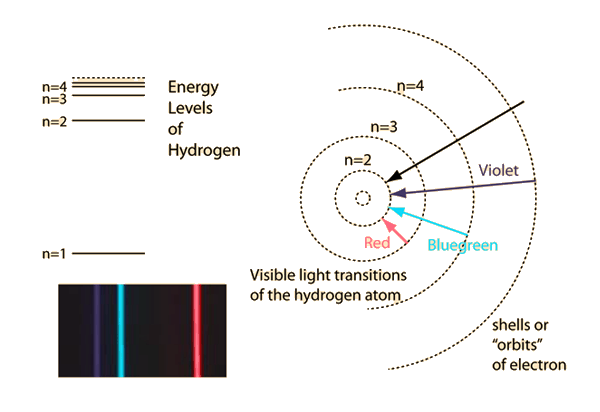
The simplest such system is the hydrogen atom. It's just an electron bound to a proton. Two particles - that's about as simple as you can get. According to QM, the electron can occupy one of a discrete set of energy levels. The electron can be excited to a higher energy level by absorbing a photon.
Quantum solution for Hydrogen
When the electron drops from a higher energy level to a lower level, it emits a photon: a quantum of light.


Quantum mechanics describes this process beautifully, but it only predicts the average time the electron will stay in the higher energy level. It doesn't give any clue as to the specific time the electron will drop to the lower level. More precisely, the transition rate (the probability of a transition per unit time) is constant: it doesn't matter how long it has been since the atom was excited, the transition rate stays the same.

Compare this to human lifetimes. There is some average human lifetime. But the probability of death ("transition to the lower state" - ha ha) depends on how long the person has been alive. A 90 year old has a much higher probability of dying in the next year than does a 30 year old.

In contrast, the electron has the same decay rate after one year as after one microsecond.

When you first encounter this, you can't quite wrap your brain around it. Surely there must be some internal mechanism, some kind of clock, that ticks along and finally "goes off," causing the transition!

But no such mechanism has ever been found. QM has had an unexcelled record of accurate predictions, without any need for such a mechanism. Further, we have good reason to suspect that, if there were such a mechanism, then QM would not be accurate in its predictions. (I'll come back to this point in a later post.) So, the absence of violations of QM is evidence that Feser's expectation - that there is always a reason for a change to happen when it does - is just wrong.

Feser seems to have missed out on the last hundred years of physics: he shows no hint that there might be a problem here. (His index includes "quantum mechanics" exactly once, in an unrelated context.) It seems that physics is not, after all, irrelevant to metaphysics.

Wednesday, May 9, 2012

Metaphysics > Physics

Feser's next job is to answer the question, "How is change possible?" The answer lies in Aristotle's distinction between actuality and potentiality (or "act" and "potency" in the traditional terminology). Thus, a rubber ball is actually blue, round, and bouncy. But it is potentially "red (if you paint it), soft and gooey (if you melt it), ... and so forth."

This distinction is the basis of the principle "Whatever changes is changed by something else." Aquinas's First Way of proving the existence of God begins from this principle, so it is an important one for Feser. He writes,

Second, and as indicated already, Aristotle holds that even though a thing's potentials are the key to understanding how it can change, this is not the end of the story. An outside source of change is also necessary. For potential gooeyness, say, precisely because it is merely potential, cannot actualize itself; only something else (like heat) could do it. Consider also that if a potential could actualize itself, there would be no way to explain why it does so at one time rather than another. The ball melts and becomes gooey when you heat it. Why did this potential gooeyness become actual just at that point? The obvious answer is that the heat was needed to actualize it. If the potential gooeyness could have made itself actual all by itself, then it would have happened already, since the potential was there already.

So, no potential can actualize itself, and in this sense anything that changes requires something outside it to change it.
 The "So" in the last sentence indicates that Feser thinks he has established his conclusion - the principle "Whatever changes is changed by something else" - in the previous paragraph. I quoted the entire paragraph so you can be sure I didn't leave out anything important. But that argument (I claim) is deficient.

The example of the ball is just that - an example. It can't be proof of anything. There's no way to argue from "In this example the thing changed is changed by something else" to "Whatever changes is changed by something else." That would be a fallacy: "One A has B, therefore all A have B."

So the argument must lie in the first part of the paragraph. Here's how I read that argument.
  1. For a change to happen, a potentiality must become actual.
  2. When a potentiality becomes actual, either
      • it actualizes itself, or
      • nothing actualizes it, or
      • it is actualized by something else.
  3. A potentiality can't actualize itself (because it is only potential, not actual).
  4. A potentiality can't be actualized by nothing (because then there would be no way to explain when the change occurs).
  5. Therefore, a potentiality must be actualized by something else.
 My complaint is with (4). This step only works if you assume that there is always a way to explain when a change occurs. But what if there isn't?


This might seem a strange complaint - unless you know something about quantum mechanics. (This is where my argument with the folks at Victor Reppert's blog began.) Since this post is already getting long, I'll leave the explanation to the next post.

Monday, May 7, 2012

Universal Truth

I'm going to try to argue that The Last Superstition fails to make the case for Feser's preferred metaphysics. I want to be clear that I'm only attempting to address Feser's argument, as presented in this book. There might be a much more effective case to be made, and maybe it can be found in Aquinas, or in Feser's other books, none of which I've read. But he presents his case in this book as an (irrefutable!) logical argument for God, so that's how I'll treat it.

One of the first things Feser tackles is the problem of universals. This philosophical problem has a 2000 year history, and is still a matter of debate today. Yet Feser claims that conceptualism and nominalism, the major alternatives to  Feser's preferred realism, are demonstrably false. I guess none of those other philosophers were smart enough to see that the problem had already been solved.

As examples of universal, Feser lists "triangularity," "humanness," and "redness." And by realism about them, he means that they "exist objectively, apart from the human mind and distinct from any material or physical features of the world."

Now, redness is an interesting choice. We now know a lot more about color perception than Aristotle did. What we know as colors are the result of a complex interaction among the light source, the surface of the colored object, the physiology of the eye, and the processing that goes on in the brain.

Start with an obvious point: "red" is an English word. We can translate it into other languages - but can we be sure that the extent of "rot" in German (for instance) coincides with "red" in English? Maybe, and maybe not. But some languages don't have a word that even vaguely resembles "red." The Jale of New Guinea have only two color terms: roughly, "brilliant" and "dull." The Tiv of Nigeria have three color terms:

 ii, which encompasses all greens, some blues, and some greys; pupu, which encompasses very light blues, light greys, and white; and nyian, which encompasses red, some browns, orange and yellow.
When someone says "The apple is red (nyian)" in Tiv, they are saying something very different than I am when I say that sentence. So it is clear that color is a culturally dependent quantity.

Even within our own culture, people can differ about what a term means. "That's not red, that's maroon!" If twenty people looked at this chart and picked out the colors they would label "red," there might not be two lists that agree. And it's not just a matter of definition: people's perceptions of color can differ dramatically. This is most obvious in color blindness, but here's a personal example that doesn't involve color blindness. When my wife and I were house hunting, we discussed one house that had (my wife thought) beautiful green marble counter-tops in the kitchen. "They weren't green, they were black!" I exclaimed. And it wasn't just a matter of lighting or recollection: we now live in that house, and my wife maintains that we have green counter-tops (with black flecks), while I am sure that they are black (with some green in them).

But if you really want proof that colors are not mind-independent, just look at the following image:


Do you see the green and blue spirals? So do I: but there aren't any green and blue spirals. Those spirals are exactly the same color. (r = 0, g = 255, b = 150) That is to say, in every objective, measurable sense, they are the same. Yet our minds interpret them as different colors.

Imagine that an extraterrestrial lands on Earth. Its physiology is completely different from ours. Maybe it doesn't even perceive light: it gets around by some sort of sonar. How would you explain why an apple and a fire engine are both red? How would you explain why two of those spirals are green and the other two blue?

 It is clear, then, that colors are not mind-independent. But that at least leaves open the possibility that other things that seem obviously mind-independent are, in fact, mind-dependent.

Friday, May 4, 2012

The Last Superstition

I've been avoiding reading Edward Feser's book, The Last Superstition: A Refutation of the New Atheism.In an attempt to understand the arguments being thrown at me in this discussion, I finally picked it up. 


Since I'm going to be trashing this book over the next few posts, I should start out by saying: you should read this book. Whether you're a theist or an atheist, it will get you thinking about arguments for God in a way you haven't ever thought about before. 


Feser is immensely smart. He is also a good writer, and entertaining in that take-no-prisoners, everyone-else-is-wrong-and-I'm-right way that reminds me of no one so much as P.Z. Myers (whom Feser detests, of course). On his blog he often goes after the New Atheists, and here he does so again. Thankfully, though, the main part of the book is the positive argument for Aristotelian-Thomian metaphysics and its implications for the existence of God. Every once in a while he hauls off and lays into Dawkins, or Dennett, or the others. These bits will either piss you off or amuse you, depending on how much you idolize these gentlemen. 

Of the Four Horsemen, I have only read Harris, who gets off rather lightly here, and I have never read Aquinas, so I don't really know whether these attacks are on target. When Feser ridicules Dawkins for misunderstanding Aquinas's argument for God, well, I suspect Feser is right - after all, this guy has spent his professional career studying Aquinas, so he probably knows better than Dawkins. But here's the odd thing: Feser also thinks his fellow philosophers are all idiots (with a few exceptions). Again and again he states that major philosophical positions are demonstrably untrue. "Abandoning Aristotelianism," he says, "was the single greatest mistake ever made in the entire history of Western thought." (Those italics are his, by the way.)


So hold onto your seat and prepare to plunge your mind into a 2000-year-old worldview.


Thursday, April 26, 2012

The Jesus Wars Continue...

Richard Carrier posts a scathing and almost unbelievably vitriolic review of Bart Ehrman's book on his (Carrier's) blog. (I don't see much of an academic future for this lad if this is how he deals with critics....) Ehrman responds on his own blog.

Tempting though it is to try to score this fight, I'm going to pass, and instead comment on a paper by philosopher Stephen Law that also addresses the existence question. (There's a shorter version at Secular Outpost.) The core idea is this premise:

(P2) Where testimony/documents weave together a narrative that combines mundane claims with a significant proportion of extraordinary claims, and there is good reason to be sceptical about those extraordinary claims, then there is good reason to be sceptical about the mundane claims, at least until we possess good independent evidence of their truth.

He concludes that

The contamination principle, P2, is a prima facie plausible principle that, in conjunction with other prima face plausible premises, delivers the conclusion that, in the absence of good independent evidence for the existence of an historical Jesus, we are justified in remaining sceptical about the existence of such a person.

Now, if Law were simply saying that we should be initially sceptical, before a detailed historical investigation, of any and all claims about Jesus that we find in the New Testament, then he is not saying anything new. NT scholars have subscribed to this view for many decades, and any competent scholar knows that they must fight strenuously for any statement to be taken as more or less accurate reflection of something Jesus actually said. (See, for example, J.D. Crossan's book The Historical Jesus to find out how this is done.)

But this is not what Law is saying. Rather, he thinks that, even after a detailed historical investigation, the very nature of the evidence means that no reliable conclusion can be obtained. He specifically considers the usual criteria that NT scholars use to evaluate individual sayings and acts, and declares them insufficient to establish a conclusion, even about basic facts like whether Jesus lived.

Not, mind you, that he has carried out such a detailed investigation and come to a negative conclusion. No, he claims that regardless of what comes out of a detailed investigation, the philosophical principles he lays out preclude a positive result.

In effect, he is saying that philosophy trumps history. This bothers me, in part because I have recently been involved in a discussion over on Victor Reppert's blog where some folks are claiming that philosophy trumps science.

But let's return to Law's "contamination principle" (P2). As many folks have pointed out, most ancient sources from the time of Jesus have supernatural episodes interlarded with portions that are generally agreed by historians to be reliable history. If we are not to reject all such sources, we must set some kind of a cut-off point: 25% miracles, dump the whole thing; 24% miracles, OK to use it. Or whatever.

Now, suppose we have a document that contains 30% miracle stories. By Law's criterion, we should dump it. But suppose that detailed historical investigation reveals that this document is actually a composite document, written by two different people at two different times. (And possibly combined into a single document by a third person, or one of the two original authors: I don't think the details matter.) And suppose that one of the source documents doesn't contain any miracles at all, while the other source contains a high percentage.

Now we have a contradiction: the contamination principle demands that we dump the document as a whole, but it allows us to retain the source document.

So it seems to me that Law's P2 cannot do what he wants it to do. It cannot circumvent the detailed historical investigation and declare it invalid. A detailed confrontation with the actual historical evidence is the only way to derive valid historical conclusions.

And that's what historians (and NT scholars) do.