Non-cognitivism in ethics is the idea that moral claims are really just expressing the speaker's attitude towards something. "Abortion is wrong," for example, amounts to "Boo on abortion!" The attitude expressed is, roughly, "I approve/disapprove of this and you should, too." But the moral claim is itself the expression of the attitude - it is not the claim that one has that attitude. That is, a moral claim is non-propositional: it doesn't have any content that is capable of being true or false.
Cognitivist philosophers respond that we seem to think moral claims have propositional content. They support this by considering the way we use moral language. Consider the claim, "If killing animals is wrong, one shouldn't eat meat." It doesn't make any sense to translate this as, "If boo on killing animals!, one shouldn't eat meat."
I think the cognitivists are probably right: when we make moral claims, we think we are making a statement that is capable of being true or false. (Whether we are right to think so is another matter.) But it seems to me that once they have considered and dismissed non-cognitivism, cognitivist philosophers forget all about the non-cognitive aspect of morality.
In the last post I gave a sketch of morality as an evolved social system that limits the actions of individuals by means of social pressure. If this view is at all correct, it is easy to see why there is a large non-cognitive component to moral claims. A strong expression of disapproval of doing X, and the resultant peer pressure to refrain from doing X, lies at the root of the moral system. (Together with the positive version: expressing strong approval of an action.)
It's harder to understand why there might be a cognitive component to morality. It seems like evolution could have given us a purely emotional response that would serve to enforce the group norms.
Let's see if the linguistic analogy helps us here. Consider "It's wrong to say, 'I am going the store to.'" Here "wrong" is not used in the moral sense, but it plays a similar role. It certainly expresses disapproval. But it also implicity invokes the rules of grammar: "It's wrong to say, 'I am going the store to,' because in English the preposition comes before its object." Notice that in grammar, the rules arise (originally) as generalizations about actual usage. They are not imposed by some linguistic authority - though various institutions (dictionaries, textbooks) might take on that authority at a later time.
It seems to me that moral claims are also two-pronged: they express approval/disapproval, but they also implicitly invoke general rules that it is assumed are accepted, or at least known, by all. "Murder is wrong" thus has the cognitive content "Murder is a violation of the generally accepted rules of behavior."
Tuesday, May 10, 2011

Saturday, May 7, 2011
The Moral Instinct
I've been trying to educate myself about ethics, metaethics, and moral philosophy, and so far I feel like I haven't encountered an approach that really makes sense of it all. But I thought I'd try to take a first pass at putting down some of my thoughts on the subject.
Let's start by asking what sort of beast morality is. I come up with something like the following:
If we ask what is the origin of such moral systems, the answer seems pretty clear: evolution. Humans, like other primates, are highly social animals. Our survival depends to some extent on our ability to cooperate with each other. Just as we have evolved an innate capacity for language, we have evolved some innate capacity for moral behavior: not just the external rules of the system, but the internal emotions that result when the rules are obeyed or disobeyed. Presumably, this sort of behavior gave a better survival rate, so that groups with stronger moral institutions (and containing individuals with stronger moral feelings) out-competed other groups. Let's summarize this as
Clearly, different cultures have implemented widely varying sorts of moral systems. I take it that what we have evolved is a basic instinct for conforming to the group morality. The specific content of that morality differs from culture to culture, and is learned. Here the language analogy is useful again: we have some innate capacity for language, but the specifics of vocabulary, grammar, etc., are learned.
All this seems rather obvious and straightforward. But it is already enough to answer some of the big questions that moral philosophers ask. In fact, it makes the search for a true account of morality look rather pointless. Why, given A1 and A2, would we expect any one "correct" moral system? That's like asking what's the correct grammar for a language to have, or what's the ideal legal system.
Here the language analogy seems to break down, however. When we hear, "Throw your father down the stairs his hat," we think, "How charming!" but when we hear of a practice like female genital mutilation, we say, "That's just wrong."
But there is a reason our response to other moral systems is different from our response to other languages. That is just what a moral system is: a system of deciding what is right and what is wrong. So we should not be surprised that we have an instinctive - maybe even irrational - response to other moral systems.
Let's start by asking what sort of beast morality is. I come up with something like the following:
A1. A moral system is a social structure that imposes limits on the actions of individuals who are part of a given social group. These limits are enforced by a system of rewards and punishments. Rewards include praise and increased social status, punishments range from shame to shunning to ostracism to death.Thus, morality acted as a legal system, back before laws and punishments were formalized and written down. But morality is more than just a system of rewards and punishments, it is internalized through feelings of pride, guilt, etc.
If we ask what is the origin of such moral systems, the answer seems pretty clear: evolution. Humans, like other primates, are highly social animals. Our survival depends to some extent on our ability to cooperate with each other. Just as we have evolved an innate capacity for language, we have evolved some innate capacity for moral behavior: not just the external rules of the system, but the internal emotions that result when the rules are obeyed or disobeyed. Presumably, this sort of behavior gave a better survival rate, so that groups with stronger moral institutions (and containing individuals with stronger moral feelings) out-competed other groups. Let's summarize this as
A2. Morality evolved as a way of subordinating the interests of the individual to the interests of the group.
Clearly, different cultures have implemented widely varying sorts of moral systems. I take it that what we have evolved is a basic instinct for conforming to the group morality. The specific content of that morality differs from culture to culture, and is learned. Here the language analogy is useful again: we have some innate capacity for language, but the specifics of vocabulary, grammar, etc., are learned.
All this seems rather obvious and straightforward. But it is already enough to answer some of the big questions that moral philosophers ask. In fact, it makes the search for a true account of morality look rather pointless. Why, given A1 and A2, would we expect any one "correct" moral system? That's like asking what's the correct grammar for a language to have, or what's the ideal legal system.
Here the language analogy seems to break down, however. When we hear, "Throw your father down the stairs his hat," we think, "How charming!" but when we hear of a practice like female genital mutilation, we say, "That's just wrong."
But there is a reason our response to other moral systems is different from our response to other languages. That is just what a moral system is: a system of deciding what is right and what is wrong. So we should not be surprised that we have an instinctive - maybe even irrational - response to other moral systems.
Friday, April 22, 2011
Taking on P.Z. Myers
Hmm, maybe this blog would be more popular if I had more octopi...

This amazing image is from the most recent Scientific American. As if that weren't cool enough, this critter confuses predators by disguising itself as a flounder.
 Isn't that a bit like a spider disguising itself as a strawberry?

This amazing image is from the most recent Scientific American. As if that weren't cool enough, this critter confuses predators by disguising itself as a flounder.

Sunday, April 17, 2011
On The Problem Of Worldviews...
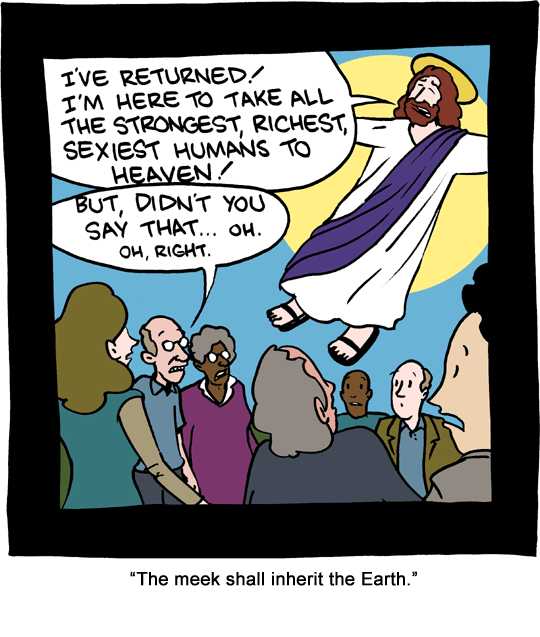
And the hovertext:
% of universe the meek shall inherit, by volume: 0.00000000000000000000000000000000000000000000000000000000003%
Friday, April 15, 2011
Theists and Atheists Agree...
Alexander Pruss of Prosblogion seems to have found an argument that theistic and atheistic philosophers agree on. From the comments:
Alexander, being a theist and a moral realist, naturally takes (3) and (4) to be true, and so concludes that either (1) or (2) is false - he then opts for naturalism being false.
I don't know enough about the whole realism/anti-realism debate to have a firm position, but I'm leaning anti-realist at the moment, so the argument doesn't present a real problem for me. But it seems to be a real problem for someone like Sam Harris, who is a naturalist and a moral realist. I don't think he would want to deny (4), either. From what I understand, he thinks that science can discover moral truths. So I wonder how Sam would respond to this argument.
But then, Sam thinks that discussions of metaethics and deontology only add to the amount of boredom in the world, so probably he wouldn't bother.
So it looks like there are a number of people who have published on this, and all the papers that I've so far looked at basically agree that the following are not all true:I don't understand all the arguments that lead up to this conclusion well enough to know whether to agree with it or not, but it's rather a fascinating conclusion if true.
1. Evolution occurred pretty much as science describes it.
2. Naturalism is true.
3. Moral realism is true.
4. We have moral knowledge.
Alexander, being a theist and a moral realist, naturally takes (3) and (4) to be true, and so concludes that either (1) or (2) is false - he then opts for naturalism being false.
I don't know enough about the whole realism/anti-realism debate to have a firm position, but I'm leaning anti-realist at the moment, so the argument doesn't present a real problem for me. But it seems to be a real problem for someone like Sam Harris, who is a naturalist and a moral realist. I don't think he would want to deny (4), either. From what I understand, he thinks that science can discover moral truths. So I wonder how Sam would respond to this argument.
But then, Sam thinks that discussions of metaethics and deontology only add to the amount of boredom in the world, so probably he wouldn't bother.
Monday, April 11, 2011
Sunday, April 3, 2011
God and the Big Bang
I used to wonder why Christians didn't make a big deal of the Big Bang. After all, it was at least one case of a "prediction" of Christianity that had been confirmed by science. Or so I thought at the time.
I found that, on the contrary, many Christians disbelieved the whole Big Bang idea and adamantly opposed it. Strange.
More recently, I have come to realize that the Big Bang is not actually a theory of how the universe began; rather, it is a theory of how the universe has changed over time. It is astounding that we can now describe the history of the universe back to 13.7 billion years ago, when it looked dramatically different than it does today. But if you try to push back further, then we have every reason to believe that our theories break down, and no reason to trust their predictions beyond a certain point.
The idea that the universe began in a singularity, which was also the beginning of time itself, is really no part of the Big Bang model (though it continues to appear in popular presentations of the theory).
This point is made in a well-thought-out paper by Hans Halvorson and Helge Kragh. (Hat tip: ex-apologist) They make a lot of other good points, too, and the whole thing is worth a read, but I was particularly struck by one thing. They ask what would happen to the theist's argument for God from the Big Bang if the theory were disproven. Would the failure of the Big Bang undermine theism? Of course not! Even if we knew the universe existed prior to the (moment we refer to as the) Big Bang, the theist could claim that God had created the universe at an earlier time, or that God had created an eternally existing universe. Then they say:
This, I think, is a very important point. And it is one that is devastating for many of the conventional arguments for God.
The basic principle is this: if X is evidence for God, then ~X ("not X", the negation of X) must be evidence against God. Or to put it another way, if X and ~X are equally consistent with the God hypothesis, then neither of them can provide an argument for God.
Swinburne, for example, claims that the constancy of physics across time and space is evidence for God. Why does an electron here on earth have the exact same mass, charge, and spin as an electron in a distant galaxy? This constancy calls out for an explanation (says Swinburne) - and the explanation is God.
But suppose that one of the many experiments looking for changes in the fundamental constants was successful. Suppose, for instance, that we found the electron's charge was changing over time. Would Swinburne take this as evidence against God? I suspect he would not. But if the God hypothesis is equally consistent with constant electric charge or changing electric charge, then constant charge cannot be evidence for God.
On a larger scale, theists often ask what is the origin of natural laws themselves. But if regularity in the operation of nature is evidence for God, then lack of regularity - randomness - in its operation must be evidence against God. And quantum mechanics shows that, at the most basic level, nature is random and unpredictable. So quantum mechanics is evidence against God!
I don't really think that quantum mechanics is a good argument against God. By the same token, I don't think the regularity of physical laws, or the constancy of particular physical parameters, or the Big Bang singularity (if there was one), are evidence for God.
I found that, on the contrary, many Christians disbelieved the whole Big Bang idea and adamantly opposed it. Strange.
More recently, I have come to realize that the Big Bang is not actually a theory of how the universe began; rather, it is a theory of how the universe has changed over time. It is astounding that we can now describe the history of the universe back to 13.7 billion years ago, when it looked dramatically different than it does today. But if you try to push back further, then we have every reason to believe that our theories break down, and no reason to trust their predictions beyond a certain point.
The idea that the universe began in a singularity, which was also the beginning of time itself, is really no part of the Big Bang model (though it continues to appear in popular presentations of the theory).
This point is made in a well-thought-out paper by Hans Halvorson and Helge Kragh. (Hat tip: ex-apologist) They make a lot of other good points, too, and the whole thing is worth a read, but I was particularly struck by one thing. They ask what would happen to the theist's argument for God from the Big Bang if the theory were disproven. Would the failure of the Big Bang undermine theism? Of course not! Even if we knew the universe existed prior to the (moment we refer to as the) Big Bang, the theist could claim that God had created the universe at an earlier time, or that God had created an eternally existing universe. Then they say:
The point is that insofar as the failure of the big-bang model would not undermine theism, so the success of the big-bang model does not support theism.
This, I think, is a very important point. And it is one that is devastating for many of the conventional arguments for God.
The basic principle is this: if X is evidence for God, then ~X ("not X", the negation of X) must be evidence against God. Or to put it another way, if X and ~X are equally consistent with the God hypothesis, then neither of them can provide an argument for God.
Swinburne, for example, claims that the constancy of physics across time and space is evidence for God. Why does an electron here on earth have the exact same mass, charge, and spin as an electron in a distant galaxy? This constancy calls out for an explanation (says Swinburne) - and the explanation is God.
But suppose that one of the many experiments looking for changes in the fundamental constants was successful. Suppose, for instance, that we found the electron's charge was changing over time. Would Swinburne take this as evidence against God? I suspect he would not. But if the God hypothesis is equally consistent with constant electric charge or changing electric charge, then constant charge cannot be evidence for God.
On a larger scale, theists often ask what is the origin of natural laws themselves. But if regularity in the operation of nature is evidence for God, then lack of regularity - randomness - in its operation must be evidence against God. And quantum mechanics shows that, at the most basic level, nature is random and unpredictable. So quantum mechanics is evidence against God!
I don't really think that quantum mechanics is a good argument against God. By the same token, I don't think the regularity of physical laws, or the constancy of particular physical parameters, or the Big Bang singularity (if there was one), are evidence for God.
Subscribe to:
Posts (Atom)